Bardot settled in Saint-Tropez and began a passionate defense of animal welfare. ‘This is my only battle,’ she said in 2013.
An icon of cinema has died.
Actress Brigitte Bardot, known for her roles in movies such as “And God Created Woman” and “Love on a Pillow,” has died at the age of 91, her animal rights foundation announced on social media on Dec 28.The Brigitte Bardot Foundation did not mention where or how its iconic founder died.
Bardot was considered a cultural icon of the 1950s and 1960s before she walked away from the spotlight and dedicated her life to animal welfare.
“A true pioneer, at the age of 39 she gave up the limelight and the world of entertainment to dedicate her fame and unwavering determination to the service of animals and the most vulnerable, such as the elderly,” a translation of her foundation’s Instagram post on Dec. 28 reads.
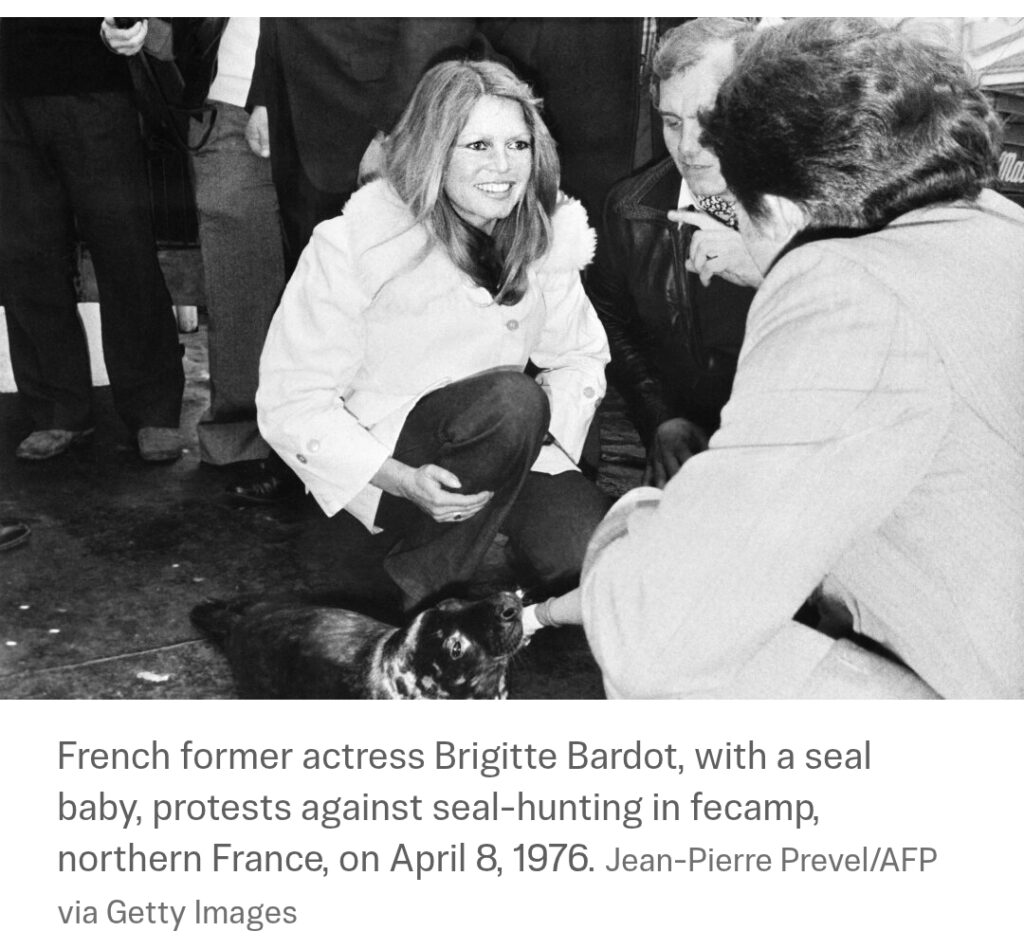
“She traveled to the Arctic ice floes in 1977 to help baby seals, an emblematic act of her fight for the protection of vulnerable species.”
The foundation, started in 1986, has rescued more than 12,000 animals in 70 countries.
“The Brigitte Bardot Foundation wishes to pay tribute to the memory of an exceptional woman who gave everything and sacrificed everything for a world more respectful of animals,” the foundation wrote.
“Her legacy lives on through the actions and campaigns that the Foundation pursues with the same passion and unwavering commitment to her ideals.”
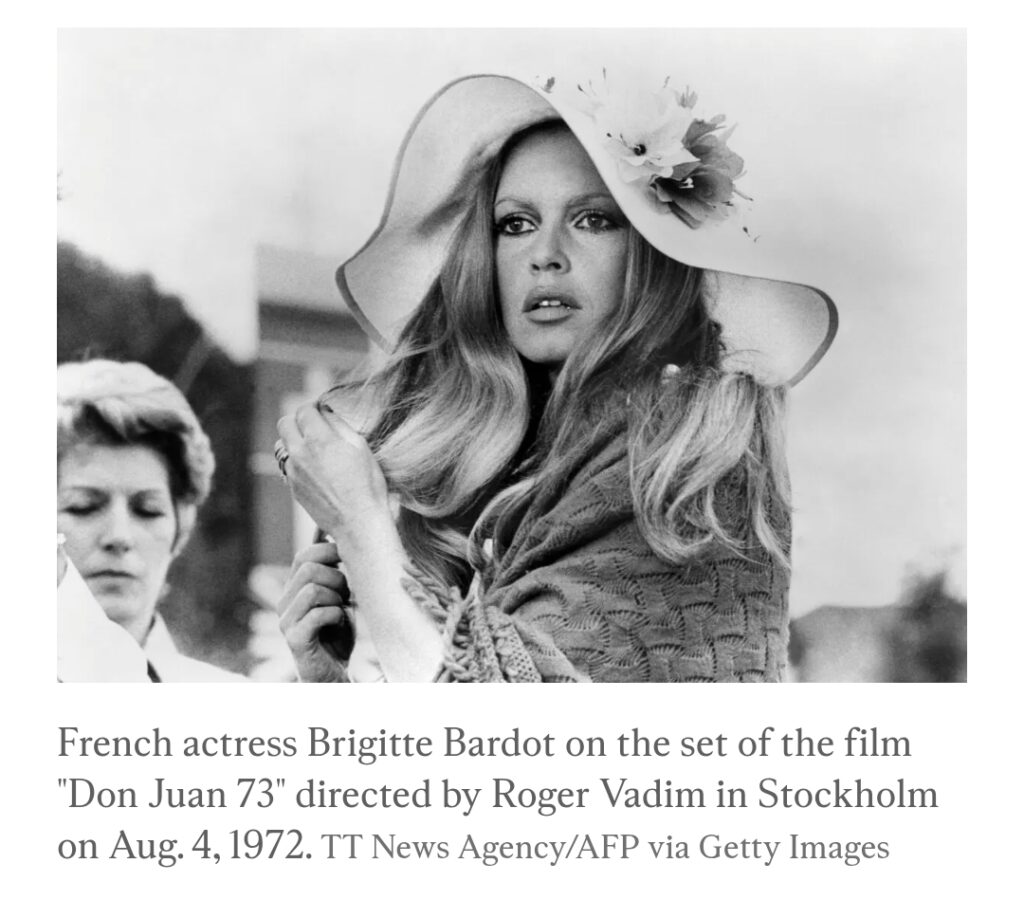
The actress, who was born in Paris, entered the entertainment industry at an early age.Bardot, often nicknamed “B.B.,” became a model as a teenager, posed in the French magazine “Elle,” and appeared in her first film, “Crazy for Love,” in 1952 before starring in American films.Her role as Juliette Hardy in the 1956 film “And God Created Woman,” directed by her then-husband, Roger Vadim, sparked controversy but was a box office success, and it made Bardot an icon.
The BAFTA nominee was chosen as the model for “Marianne,” the national emblem of France and official seal of the country. For 30 years, her facial features appeared on statues, postage stamps, and coins.
“Her films, her voice, her dazzling glory, her initials, her sorrows, her generous passion for animals, her face that became Marianne, Brigitte Bardot embodied a life of freedom,” French President Emanuel Macron wrote in an X post on Dec. 28.
“French existence, universal brilliance. She touched us. We mourn a legend of the century.”
Struggle With Fame
Bardot often spoke of being a prisoner of her own fame, unable to enjoy life’s simple pleasures.
“Nobody can imagine how horrific it was, such an ordeal,” she reflected decades later. “I couldn’t go on living like that.”
Her personal life was shaped by four marriages, widely reported affairs, and well-documented struggles with depression. Two years after she split from Vadim, Bardot married French actor Jacques Charrier in 1959, and they had one child, Nicolas.
On her 26th birthday, she was found unconscious at a house on the French Riviera after trying to take her own life. Rumors of another attempted suicide surfaced years later when she mysteriously canceled a 49th birthday party, then appeared in the hospital.
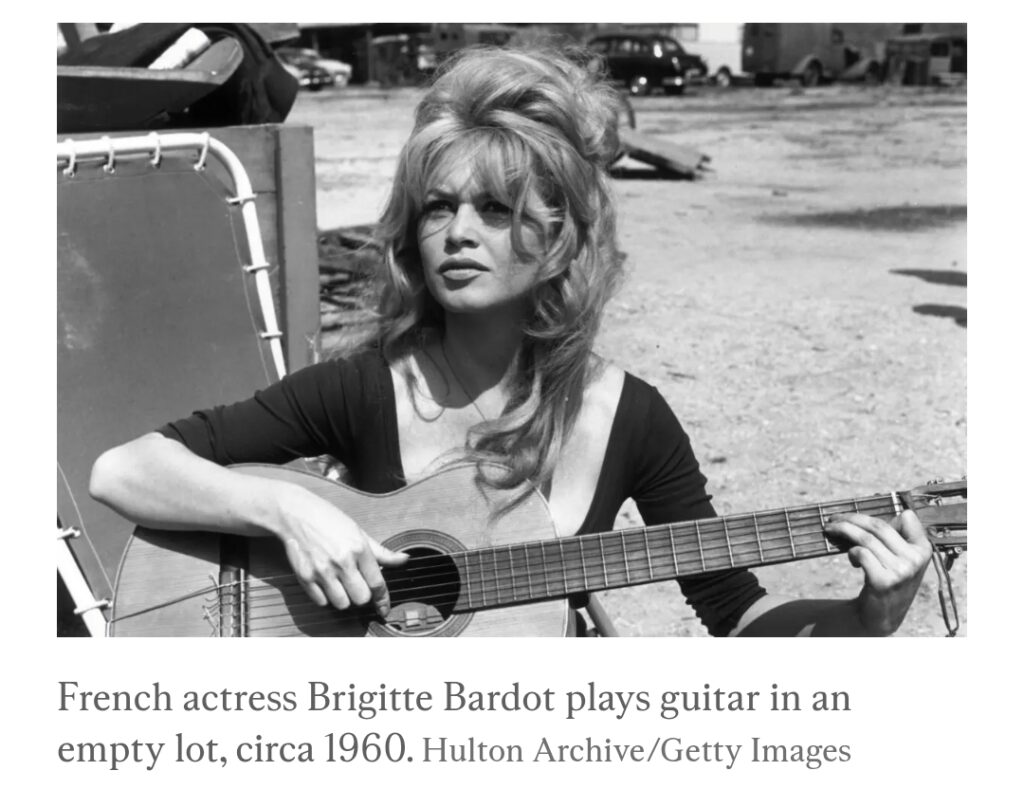
Alongside her acting, Bardot enjoyed a successful music career. Her collaborations with singer-songwriter Serge Gainsbourg, including the erotic “Je t’aime … moi non plus” (“I Love You … Neither Do I”), drew both acclaim and controversy.
But she said she found little satisfaction in the praise she garnered.
“I have been very happy, very rich, very beautiful, much adulated, very famous and very unhappy,” she told the magazine Paris Match around the time of her 50th birthday. “I’ve been let down too often. I’ve had really terrible disappointments in my life. That is why I’ve chosen to withdraw, to live alone.”
‘This Is My Only Battle’
Bardot made the last of her 42 films in 1973. Disenchanted with the industry, she declared the world of cinema “rotten” and left public life.
“I will have given 20 years of my life to cinema, that’s enough,”
she said in a TV interview at the time.
She settled in the fashionable French resort of Saint-Tropez, where she found solace among animals and the Mediterranean landscape.There, she began a passionate defense of animal welfare.
“This is my only battle, the only direction I want to give my life,” Bardot said in 2013.
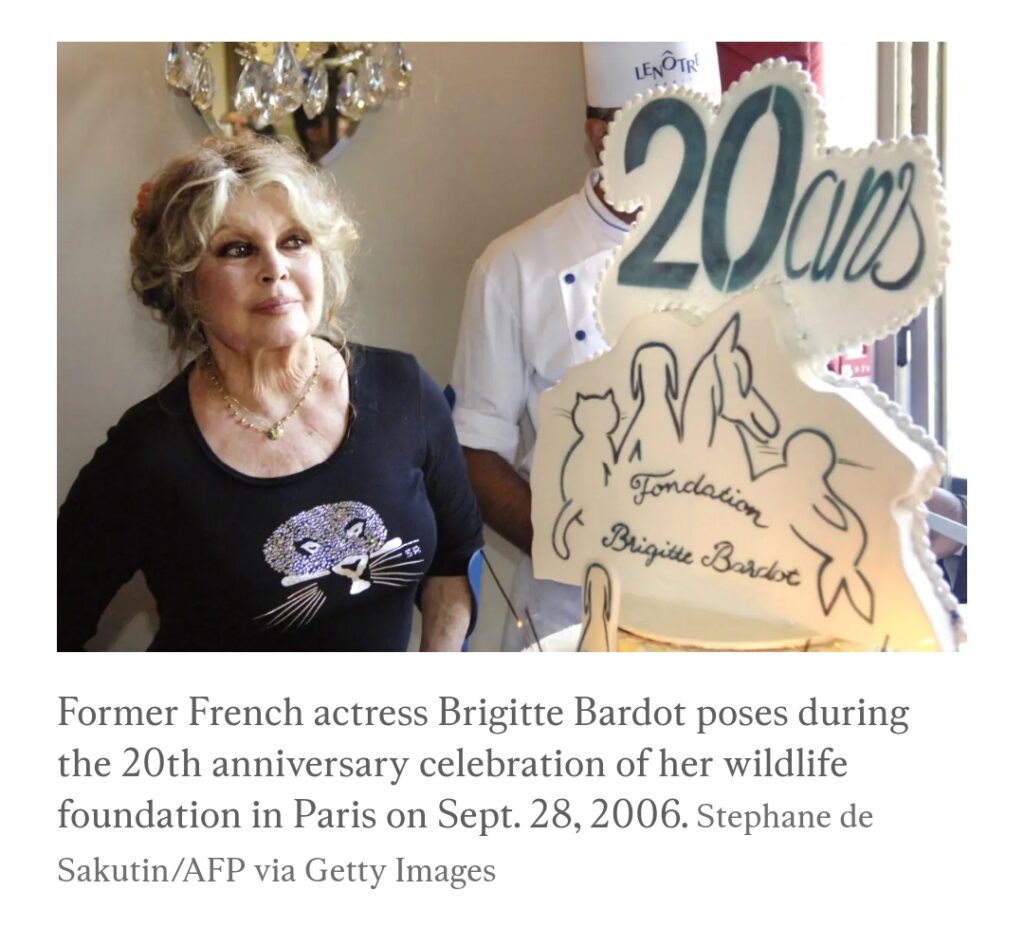
Her devotion to animals became legendary. In 1986, she established the Brigitte Bardot Foundation for the Welfare and Protection of Animals, auctioning off personal souvenirs the following year to raise funds for her cause.
Bardot supported high-profile activists, such as anti-whaling campaigner Paul Watson, and campaigned vigorously against animal cruelty, at times threatening to leave France over animal welfare disputes.
When actor Gérard Depardieu accepted Russian citizenship after a public spat with French authorities, in 2013, Bardot threatened to follow suit if France euthanized two sick circus elephants.
For much of the latter part of her life, Bardot lived alone behind high walls in Saint-Tropez, surrounded by a menagerie of cats, dogs, and horses.
This passion, she often suggested, was an antidote to her disappointing relationships.
“I gave my beauty and my youth to men,” she once said. “I am going to give my wisdom and experience to animals.”
Advocacy
As her advocacy intensified, so did the backlash to her political statements.Bardot’s public remarks on immigration, Islam, and homosexuality led to a string of convictions for inciting racial hatred.
Between 1997 and 2008, she was fined six times by French courts for her comments, particularly those targeting France’s Muslim community.In one case, a Paris court fined her 15,000 euros ($17,000) for describing Muslims as a population that was “destroying [France] by imposing its acts.”
In 1992, she married Bernard d’Ormale, a former adviser to the right-wing National Front, and later publicly endorsed the party’s successive leaders, Jean-Marie Le Pen and his daughter Marine Le Pen. Bardot called the latter “the Joan of Arc of the 21st century.
”All through her life, Bardot’s influence endured, whether in fashion—with media noting regular comebacks of her trademark hairstyle—or through regular documentaries and coffee table books celebrating her rare impact on French cinema.
Asked by French channel BFM TV in May 2025 whether she considered herself a symbol of the sexual revolution, she said: “No, because before me, plenty of wild things had already happened—they didn’t wait for me. Feminism isn’t my thing; I like men.”
In the same interview, she was asked how often she reflected on her film career.“I don’t think about it,” she said, “but I don’t reject it, because it’s thanks to it that I’m known everywhere in the world as someone who defends animals.”