For 80 years, what bound the United States to Europe was a shared commitment to defence and a common set of values: a pledge to defend democracy, human rights, and the rule of law.
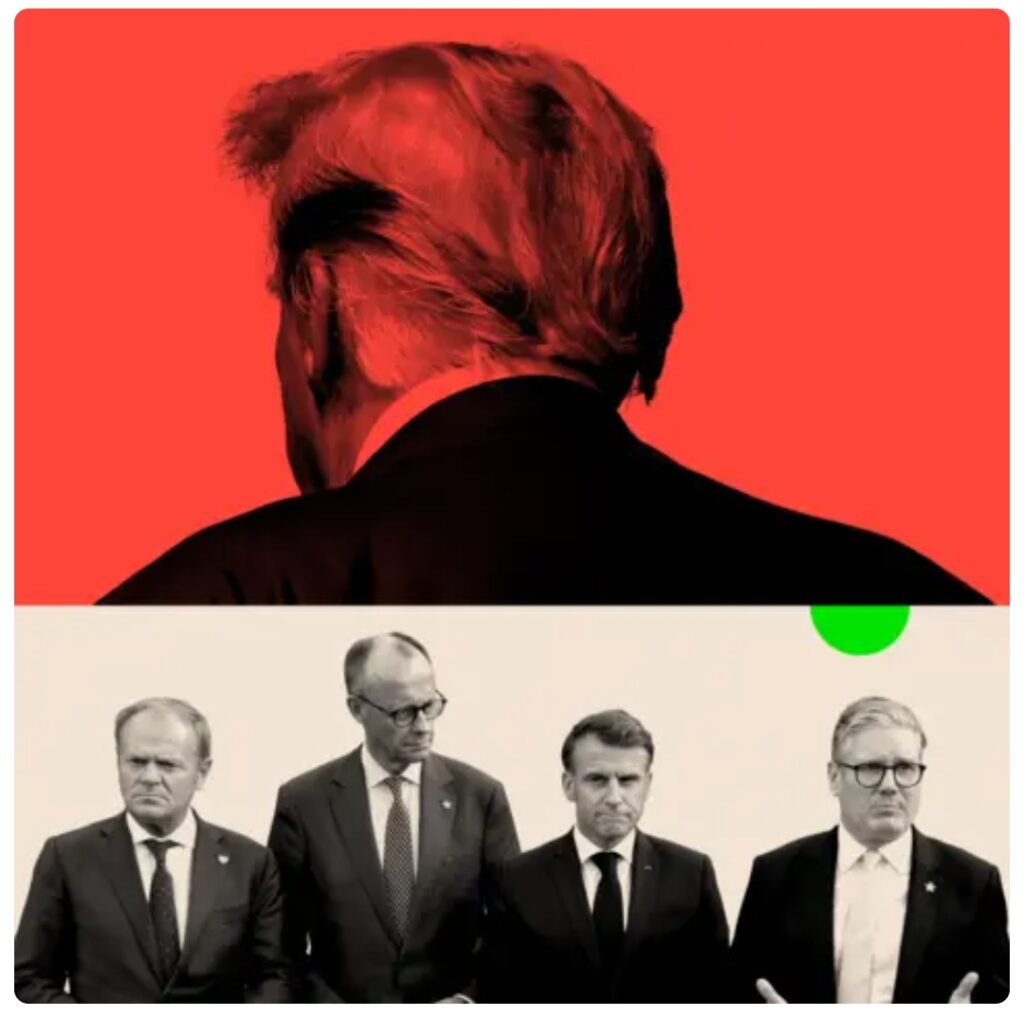
That era began in March 1947 with an 18-minute speech by President Harry Truman, in which he pledged US support to defend Europe against further expansion by the Soviet Union.
America led the creation of NATO, the World Bank, the IMF, and the United Nations. It bound itself to what became known as the “rules-based international order,” under which nation-states committed to mutual obligations and shared burdens designed to defend the democratic world against hostile authoritarian powers.
Now, the new US National Security Strategy (NSS), published in December, signals that this shared endeavour has ended and that much of what the world has long assumed about America’s role is over.
The review refers to the “so-called ‘rules-based international order’,” placing the phrase in inverted commas — a delegitimisation by punctuation.Vice-President JD Vance warned America’s European allies of this shift in a speech at the Munich Security Conference in February 2025.
He told them bluntly that the real threat to Europe did not come from Russia but from within — from those censoring free speech, suppressing political opposition, and undermining European democracy. He was particularly critical of what he called the “leftist liberal network.”
The French newspaper Le Monde described the speech as a declaration of “ideological war” against Europe.Last month’s NSS codifies Vance’s remarks and elevates them to the level of doctrine.
“Certainly America is no longer the country that promoted the global values that have been in place since the end of the Second World War,” says Karin von Hippel, a former senior US State Department official and former director of the Royal United Services Institute. “It is shifting to a very different place.”
If the world is indeed moving away from that order, the question becomes: what is it moving toward — and what does that mean for Europe?
“We have a different world today,” says Victoria Coates, vice-president of the Heritage Foundation and a former deputy national security adviser to President Donald Trump.“
International institutions, notably the United Nations, have been marked by dramatically anti-American sentiment and have not served our or any other particular purpose,” she argues.
Coates says the rules-based order was created 80 years ago in a world where China was not a major concern. “We just have a different world today.”
The post-war international order was built by leaders shaped by an era of Great Power politics and catastrophic global conflict. Though flawed and incomplete, it was the product of that experience.The NSS argues that American strategy later went astray, blaming what it calls “American foreign policy elites.”
“They lashed American policy to a network of international institutions, some driven by outright anti-Americanism and many by a transnationalism that seeks to dissolve state sovereignty,” the document states.
It signals that the US will seek to roll back the influence of supranational bodies.
“The world’s fundamental political unit is and will remain the nation-state… We stand for the sovereign rights of nations, against the sovereignty-sapping incursions of the most intrusive transnational organizations…”
Elsewhere it states: “The outsized influence of larger, richer, and stronger nations is a timeless truth of international relations.”
The Kremlin responded positively, saying much of the review aligned with Moscow’s thinking.“I think Trump, Xi, Putin and their more authoritarian acolytes are seeking to return us to an era of Great Power politics,” says Field Marshal Lord Richards, former head of the UK’s armed forces.
However, Sir Lawrence Freedman, emeritus professor of war studies at King’s College London, cautions against romanticising the past.“
We should be careful about nostalgia. There were plenty of violations of the rules — Vietnam, for example. The past was complex.”
The NSS reflects a more muscular assertion of unilateralism, exemplified by the US military operation in Caracas that led to the capture of Venezuela’s leader Nicolás Maduro and his wife.Some international law experts questioned the legality of the action. The US maintains it was lawful.
“Under American law it certainly was,” says Robert Wilkie, a former undersecretary of defense. “Maduro is not recognised by most of our European partners, making him an illegitimate figure.”
The NSS asserts the US’s right to be the pre-eminent power in the Western Hemisphere — a reassertion of the 1823 Monroe Doctrine.China’s growing influence in Latin America is explicitly targeted.
But Freedman notes that US power still has limits. “They may have removed Maduro, but they are not running the country.”
Under the new strategy, the US will no longer pressure authoritarian regimes over human rights.“All nations are entitled by ‘the laws of nature and nature’s God’ to a ‘separate and equal station,’” the review declares.
In the Middle East, the US says it will abandon efforts to pressure regimes to change their political systems, instead accepting nations “as they are.”
Yet this tolerance does not appear to extend to Europe.The NSS criticises Europe’s “current trajectory,” warning of “civilizational erasure” and questioning whether some NATO members can remain reliable allies.
“It’s a very nativist document,” says von Hippel. “It implies a threat to the dominance the Christian white male has historically held, without stating it explicitly.”
Coates, however, argues the struggle is civilisational and centred on sovereignty, particularly regarding the European Union.The strategy calls for “cultivating resistance to Europe’s current trajectory” from within European nations — language that raises serious concerns.
After Vance’s Munich speech, Germany’s chancellor said Europe would need to “achieve independence” from the US, though experts say this will take years and enormous expense.“Europe can’t rely on the Americans,” says Freedman, “but it can’t easily operate without them either.”
Lord Richards warns Europe risks “falling between the cracks” — unable to act as a Great Power yet still dependent on the US within a reshaped NATO.The report reveals not just a transatlantic divide, but one that cuts through both continents.
“It’s a popular revolt against the establishment,” says journalist Victor Mallet, pointing to shared concerns over immigration, inequality, and cultural identity.
The NSS commits to scrapping policies such as Diversity, Equity, and Inclusion, and reflects how America’s culture wars now shape its foreign policy.
Russia is notably not identified as a hostile power, despite its invasion of Ukraine.
For some in Trump’s political base, Vladimir Putin is seen not as an enemy but as a defender of white, Christian nationalist civilisation — a model they admire in Donald Trump himself