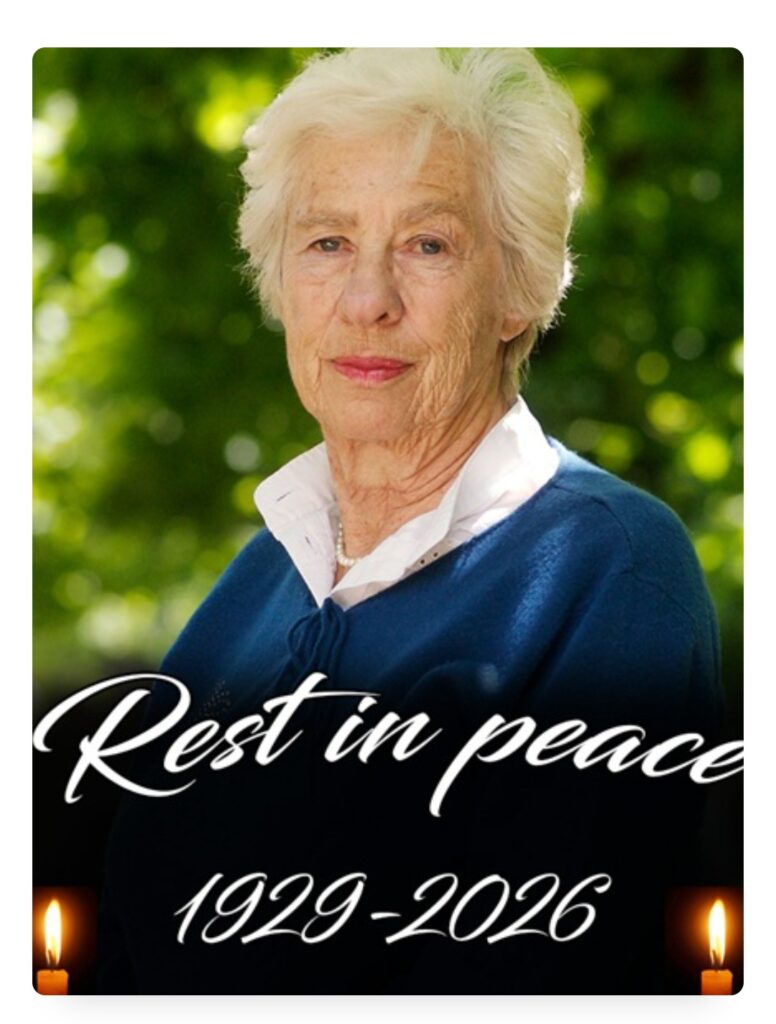
Eva Schloss, the stepsister of Anne Frank and one of the last living direct witnesses to the Holocaust, passed away at the age of 96, marking the loss of a powerful voice that spent decades educating the world about the dangers of hatred, intolerance, and forgetting history.
Born Eva Geiringer on May 11, 1929, in Vienna, Austria, she grew up in a loving Jewish family alongside her parents and older brother, Heinz. Her early childhood was stable and ordinary—until March 1938, when Nazi Germany annexed Austria in the Anschluss. Jewish families were suddenly stripped of rights, safety, and livelihoods, forcing many to flee.
Recognizing the growing danger, the Geiringer family escaped to Amsterdam, settling near Merwedeplein Square in the Rivierenbuurt neighborhood. There, Eva met Anne Frank, another Jewish refugee. The girls played together and shared moments of childhood innocence, unaware that history would forever connect their names.That sense of safety was short-lived. In May 1940, Nazi Germany invaded the Netherlands, and anti-Jewish laws were quickly enforced. Jewish children were expelled from schools, businesses were seized, and deportations began. Like the Frank family, the Geiringers went into hiding.Their hiding place was eventually betrayed by a nurse who collaborated with the Nazis. On May 11, 1944—Eva’s fifteenth birthday—she and her family were arrested and deported to Auschwitz-Birkenau.
At Auschwitz, Eva was separated from her father and brother. She and her mother endured forced labor, starvation, disease, and constant fear. Her father, Erich Geiringer, and her brother, Heinz, were murdered in the camp. Eva and her mother survived until the camp was liberated in January 1945.
After the war, Eva and her mother returned to Amsterdam. Later, her mother, Elfriede Geiringer, married Otto Frank, Anne Frank’s father and the sole survivor of the Frank family. Through this marriage, Eva became Anne Frank’s stepsister.
For decades, Eva remained silent about her experiences, struggling with trauma and grief. It was not until the late 1980s that she began speaking publicly, motivated by concern that the lessons of the Holocaust were being forgotten as racism, antisemitism, and war persisted.
From that point on, Eva dedicated her life to Holocaust education. She traveled extensively, speaking to students, educators, prisoners, and communities around the world. She emphasized that the Holocaust did not begin with gas chambers, but with words, exclusion, and silence—and that ordinary people’s moral choices matter.
In 1996, Eva recorded her testimony for the USC Shoah Foundation’s Visual History Archive and also contributed to the Anne Frank House’s educational programs. She co-founded the Anne Frank House UK Trust and served as its honorary president.
Eva received numerous honors for her work, including an honorary doctorate from the University of Northumbria and appointment as a Member of the Order of the British Empire (MBE). In 2021, Austria restored her citizenship, acknowledging the injustice inflicted on her family decades earlier.She spent her later years in London, remaining active in education well into her 90s. Following her death on January 3, tributes poured in worldwide. King Charles III praised her lifelong commitment to overcoming hatred and promoting courage, understanding, and resilience.
Eva Schloss is remembered not only as a Holocaust survivor and educator, but as a devoted mother, grandmother, and great-grandmother. She often said she spoke not to relive the past, but to prevent its repetition.Her legacy lives on through her testimonies, writings, and the countless lives she touched—reminding the world that remembrance is a responsibility shared by all.
Rest in peace, Eva Schloss.