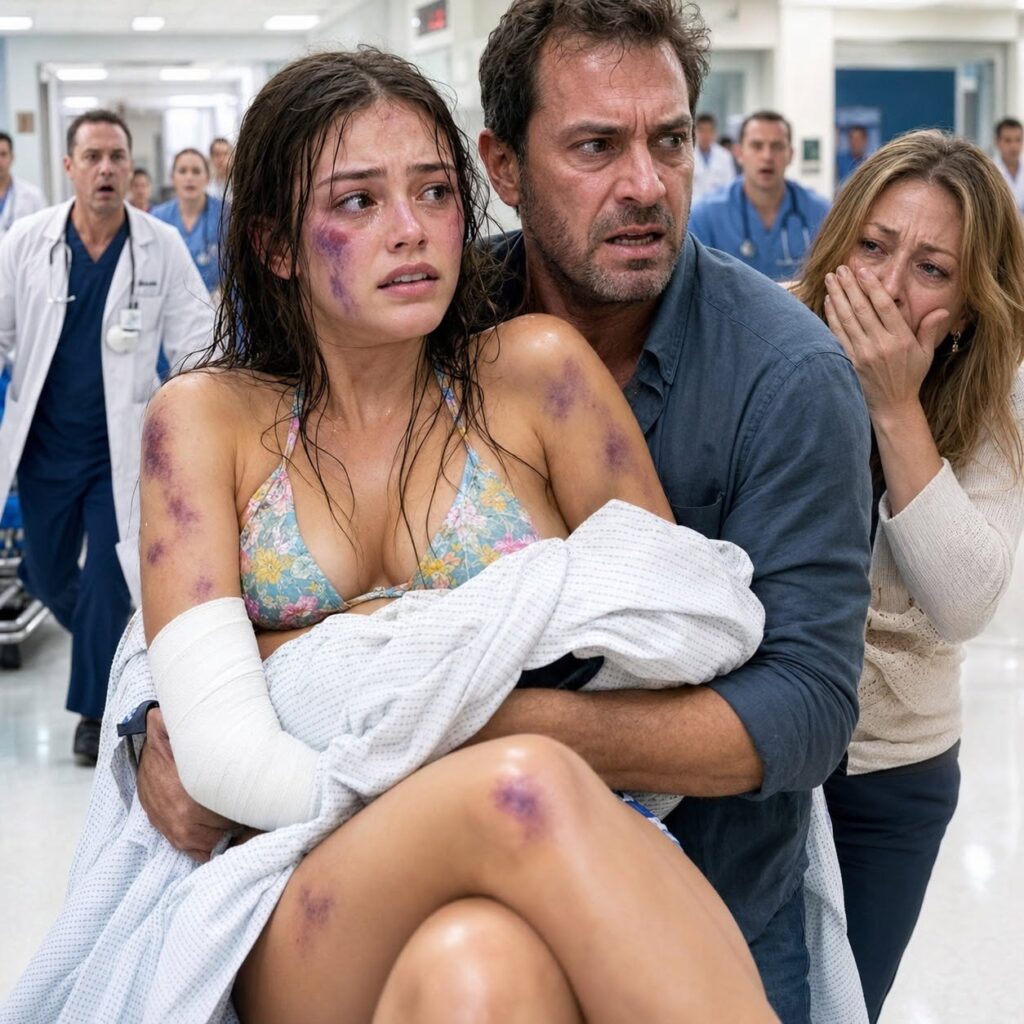
The day my stepfather broke my arm, my mother lied faster than I screamed. She held my
good wrist in the hospital lobby and whispered, “Cry wrong, and you’ll never see sunlight
again.I was seventeen, small enough for them to call me weak, old enough to know the difference
between a house and a cage. My stepfather, Carl Mercer, liked to beat me after dinner. Not
because I talked back. Not because I failed school. He did it because he enjoyed watching
fear change my face.
“Dance, little orphan,” he would say, circling me with a beer in his hand while my mother sat
on the couch, scrolling through her phone like I was a loud commercial.My real father had died when I was nine. He left me two things: his last name and a locked
cloud account full of old family videos. At least, that was what everyone thought. Carlthought Dad had left me nothing useful. Mom thought I was too broken to remember
passwords.
They were both wrong.
For years, I learned silence the way other girls learned makeup. I learned which floorboards
creaked. I learned where Carl hid his cash, where Mom kept her forged signatures, and how
their voices changed when they were lying. I learned to record without looking like I was
recording.An old phone, cracked at the corner, stayed hidden behind a loose vent in the living room.
Another one lived inside a cereal box on top of the fridge. Every slap, every threat, every
laugh after pain—saved, uploaded, backed up.
I didn’t use it yet.
I was waiting for someone outside that house to look at me and believe what they sawThat night, Carl twisted my arm until something snapped. Mom’s face went white for one
second, then hard again.
“Bathroom,” she said sharply. “You slipped.”
At the hospital, she smiled at the nurse. “She’s clumsy. Always has been.”The doctor came in ten minutes later. Dr. Nathan Ellis. Calm eyes. Careful hands. He looked
at my arm, then at the yellowing bruises near my jaw, the finger marks fading on my neck.
He didn’t ask my mother anything.He looked straight at me and said softly, “Did you fall?”My mother squeezed my wrist.
I raised my eyes.
“No,” I said. “I survived.”
Dr. Ellis stepped out.
Thirty seconds later, he called 911.
Part 2
My mother’s smile cracked when two police officers entered the room. Carl had gone outside
to smoke, convinced the hospital visit was already under control. He always believed fear
was a leash, and he had spent years tightening mine.
“Is this necessary?” Mom snapped. “My daughter is emotional. She makes things up when
she wants attention.”
Dr. Ellis stood between us. “She has injuries in different stages of healing.”
Mom laughed too quickly. “Teenagers are dramatic.”
I looked at her and said nothing.
That scared her more than crying.
An officer named Ramirez asked if I wanted to speak privately. Mom lunged forward.
“She’s a minor. I’m her mother.”
Ramirez didn’t blink. “And right now, you’re part of the investigation.”
They moved me to another room. For the first time in years, a door closed and Carl was on
the other side of it.
Ramirez sat beside my bed. “Can you tell me what happened?”
I could have spilled everything like blood. Instead, I gave her the beginning, not the ending.
“My stepfather hurts me,” I said. “My mother helps him hide it.”
Ramirez’s expression hardened. “Do you have proof?”
I looked down at my broken arm. “More than he thinks.”
When Carl stormed in twenty minutes later, he was smiling. That was his performance face
—the one he used for neighbors, teachers, church volunteers, anyone with a clean shirt and
easy trust.
“Sweetheart,” he said, spreading his arms. “You scared us.”
I stared at him.
His eyes warned me to obey.
Mom stepped beside him, regaining confidence. “See? She’s confused. She hit puberty and
became impossible. We’ve tried everything.”
Carl sighed at the police like a tired saint. “Kids today. You discipline them, they call it
abuse.”
Dr. Ellis’s jaw tightened.
Then my phone rang.
Not the cheap phone Mom allowed me to have. The old emergency phone hidden in my
backpack. Mom’s eyes widened when she saw it.
I answered with my left hand.
A woman’s voice came through the speaker. “Maya? This is Attorney Claire Whitman. I
received the automatic evidence packet. Are you safe?”
Carl froze.
Mom whispered, “What evidence packet?”
My father had been a cybersecurity consultant. Before he died, he taught me that secrets
needed backups and backups needed witnesses. When Carl broke my arm, I used the
emergency shortcut I had built from Dad’s old notes. Three taps sent years of videos, audio
files, photos, dates, and medical notes to three places: a lawyer, a child advocacy center,
and my father’s sister, Aunt June, who had been trying to get custody of me for six years.
Claire’s voice turned cold. “Maya, do not speak to your mother or stepfather. Police should
secure the residence immediately. There is also evidence of financial theft from your father’s
estate.”
Mom grabbed the bed rail. “You little liar.”
Carl’s face changed from charming to ugly. “Give me that phone.”
Officer Ramirez stepped in front of him.
“Sir,” she said, “take one more step and I’ll cuff you in front of everyone.”
For the first time in my life, Carl stopped when someone told him to.
Part 3
They arrested Carl in the hospital parking lot.
He shouted that I was unstable, ungrateful, poisoned by the internet. He called me a liar so
many times the word began to sound like a prayer he hoped would save him. But Ramirez
had already watched the first video.
In it, Carl stood in our living room laughing while I begged him to stop.
In another, my mother said, “Hit where clothes cover it.”
After that, nobody asked if I had slipped.
The house was searched before sunrise. Police found the hidden phones exactly where I
said they would. They found my journal sealed in plastic under a loose floorboard. They
found forged documents in my mother’s desk and bank transfers from my college fund into
Carl’s gambling account.
Mom tried to cry when Aunt June arrived.
“My baby,” she sobbed, reaching for me.
I stepped behind my aunt.
“No,” I said. “You chose him every day.”
Her face collapsed, but not from guilt. From losing.
The courtroom three months later was bright, cold, and silent. Carl wore a suit that didn’t
fit. Mom wore pearls like innocence could be accessorized.
Their lawyer called me troubled. He called my recordings “teenage manipulation.” He
suggested I injured myself for attention.
Then Attorney Whitman stood.
She played one audio clip.
Carl’s voice filled the courtroom: “Nobody will believe you. Your mother will swear you fell.”
Then Mom’s voice followed: “Make sure she says bathroom.”
The jury stopped looking at me like a damaged girl. They looked at Carl and my mother like
they were finally seeing the room I had lived in.
Carl was convicted of aggravated assault, child abuse, witness intimidation, and evidence
tampering. My mother was convicted of child endangerment, obstruction, and fraud. The
judge ordered restitution from the stolen estate money. Their house was sold. Carl’s friends
disappeared. Mom’s perfect church circle became empty pews around her.
When the sentence was read, Carl turned and hissed, “You ruined this family.”I met his eyes.
“No,” I said. “I documented what you built.”
Aunt June took me home that evening. Not to my old house. To hers, where the walls were
pale blue, the locks worked, and nobody yelled after sunset.
Six months later, my cast was gone. My arm still ached when it rained, but I could hold a
paintbrush again. I graduated with honors and accepted a scholarship to study digital
forensics, because I had learned young that truth needed protection.
On my eighteenth birthday, Aunt June gave me a small silver key.
“It’s for your father’s storage unit,” she said. “He saved everything for you.”
Inside were boxes of photos, his old camera, and a note in his handwriting.
Maya, if the world ever makes you feel small, remember: quiet people can still move
mountains.
I sat on the floor and cried, not from fear this time, but because peace felt so new it almost
hurt.
Carl wrote letters from prison. I never opened them. My mother requested visitation. I
declined every time.
Some people call revenge loud.
Mine was quiet.
It wore a hospital bracelet, carried a broken arm, pressed three buttons, and let the truth
walk into the light.