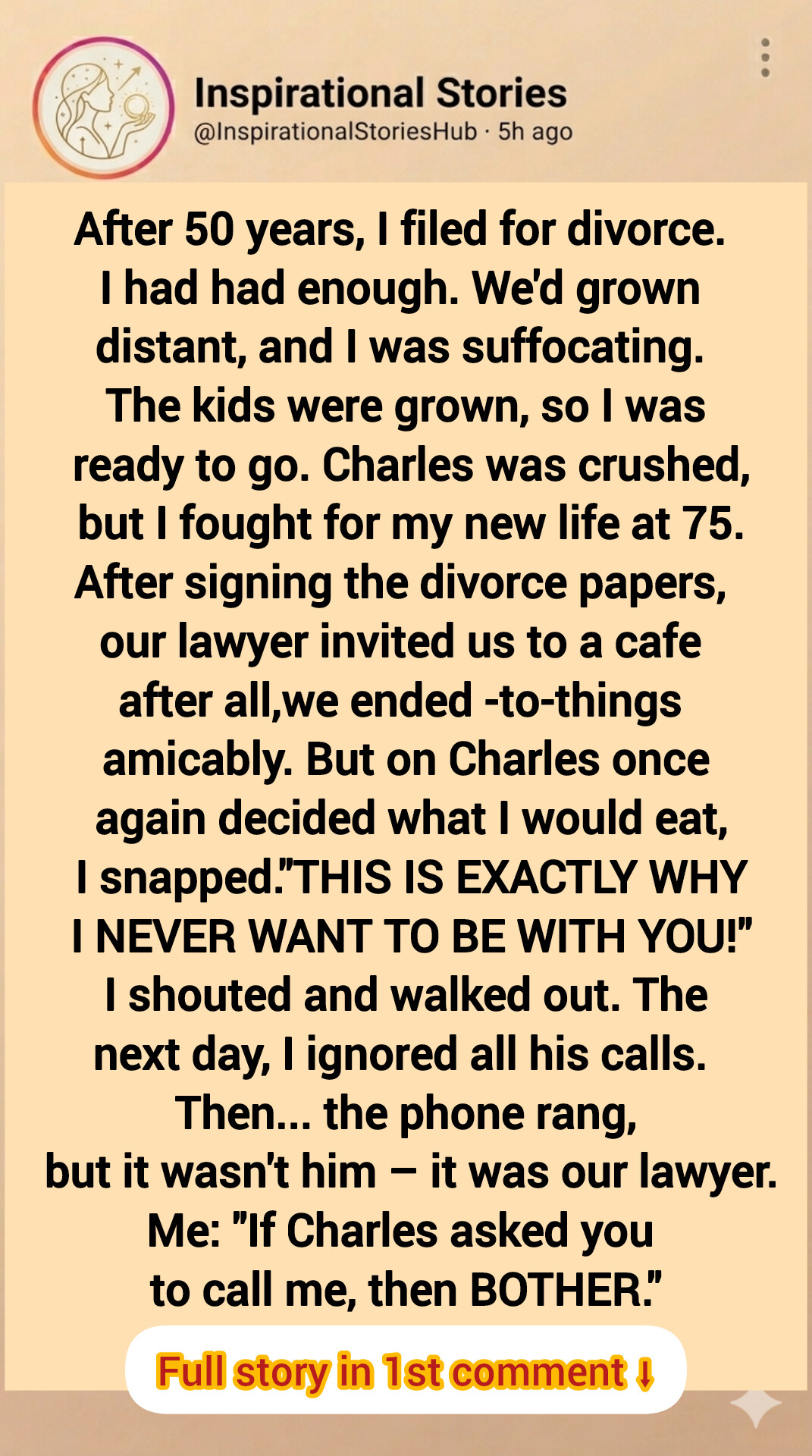
After 50 years, I filed for divorce. I had had enough. We’d grown distant, and I was suffocating. The kids—Sarah and David—were grown, living their own busy lives in Chicago and Boston, so I was finally ready to go. Charles was crushed.
He didn’t understand it. To him, we had lived the great American dream. A beautiful house in the suburbs, a stable family, a half-century of shared history. But I was fighting for my new life at 75. The pain of my marriage wasn’t born of screaming matches or shattered glass. It was a quiet, insidious ache. It was the profound loneliness of sitting next to someone on the sofa every evening and feeling like a ghost in my own living room. Charles never saw himself as a controlling husband.
He thought he was being a provider, a protector. But his protection felt like a tightening leash. Over the decades, he slowly erased me. It was in the little things. He picked our vacation destinations. He managed the finances without letting me see the ledgers. And, most maddeningly, he spoke for me. If we went out to a restaurant, before I could even open my mouth to speak to the waiter, Charles would say, “She’ll have the roasted chicken, no butter on the potatoes.” He thought it was romantic that he knew my order. He never realized he was robbing me of my own voice.
When I finally signed the divorce papers in downtown Seattle, my hand trembled. The pen felt like it weighed fifty pounds. My heart was a chaotic storm of emotions. Guilt gnawed at me—*was I abandoning him after all these years?* Fear whispered in my ear—*who am I, at 75, without a husband?* But beneath the guilt and the fear, a small, stubborn flame of relief flickered to life. I felt strong.
After signing the papers, our lawyer, Mr. Davis, invited us to a cafe across the street. We had, after all, ended things amicably on paper. I agreed, thinking we could share one last cup of coffee as two adults closing a long chapter. We sat in the booth, the tension thick but manageable. The waitress walked over, pad in hand. I opened my mouth to ask for a slice of cherry pie—something I hadn’t eaten in years because Charles thought it was too sugary. Before a sound could leave my lips, Charles smoothly intervened. “We’ll just have two black coffees. And a bran muffin for her to split. She needs to watch her cholesterol.”In that fraction of a second, fifty years of silenced opinions, unsentimental anniversaries, and un-ordered cherry pies collided in my chest. I snapped. “THIS IS EXACTLY WHY I NEVER WANT TO BE WITH YOU!” I shouted, the volume of my own voice startling even me. The cafe went dead silent. I didn’t care. I stood up, my hands shaking, grabbed my coat, and walked out into the cold afternoon air. The next day, sitting in my new, small apartment, I ignored all his calls. The silence of the rooms was both terrifying and intoxicating. Then… the phone rang again. It wasn’t Charles’s number. It was our lawyer.
I answered, my voice cold. “If Charles asked you to call me, then don’t bother, Mr. Davis.””He didn’t ask me to call you to argue, Martha,” Mr. Davis said gently. “He dropped off the final, finalized copy of the decree for you. But he left a note attached to it. He asked me to read it to you, only if you were willing to listen.”
I gripped the phone, my knuckles white. “Read it.”Mr. Davis cleared his throat. *”Martha,”* he read, *”When you yelled at the cafe yesterday, I was angry. But then I went home to an empty house and thought about the muffin. And the chicken. And the vacations. I never asked you what you wanted because I arrogantly thought my job was to make decisions for us. I thought that was love. I see now that I spent fifty years loving my idea of you, without ever letting you be yourself. Eat the cherry pie, Martha. You deserve to taste your own life. I am so sorry.”*
Tears blurred my vision, hot and fast. It didn’t change my mind—I wasn’t going back. The marriage was over. But in that moment, the heavy, suffocating weight I had carried for half a century finally lifted. He finally saw me. And more importantly, I finally saw myself.
I hung up the phone and walked into my small, sunlit kitchen. I felt lighter than I had since I was twenty years old. At 75, I learned the most important lesson of my life: It is never too late to choose yourself. Love without respect for a person’s autonomy is not love; it’s just management. A golden cage is still a cage. Growth and freedom don’t have an expiration date. Your life is yours to live, and it is entirely up to you to order exactly what you want from it.