The water from our kitchen faucet always runs rust-colored for the first few seconds. I watched it swirl down the drain, waiting for it to clear before filling the dented kettle. Behind me, the rhythmic, shallow breathing of my husband, David, filled our cramped apartment. He was carefully rationing out his heart medication on the worn formica table, a quiet concentration in his tired eyes. Five years ago, we had blueprints rolled up in a cardboard tube. We were going to open a small, community bakery.
David had the golden touch with sourdough, and I had a mind for numbers. But then his heart started failing. The bakery fund bled into hospital copays, then into specialists, and finally into the sheer, crushing weight of daily survival. I set a mug of hot water and half a slice of toast in front of him. “I already ate,” I lied smoothly, forcing a smile. My stomach tightened in response, a dull ache I’d grown used to.
David looked at me, his eyes bruised with exhaustion. He knew, but he also knew that calling me out would strip away the fragile illusion keeping us afloat. He took a bite of the dry toast, swallowing his pride with it. “Thank you, Maya. It’s perfect.”That evening, we had somewhere to be. It was our college friend Julian’s fortieth birthday. Years ago, Julian, David, and I used to split cheap pizzas on the floor of our dorms.
Now, Julian owned a logistics firm, and his home was a sprawling, glass-walled estate in the hills. We hadn’t seen our old circle in over a year, but the invitation had felt like a summons we couldn’t ignore, a desperate grasp at the lives we used to lead.I wore my best dress—a navy blue sheath I’d bought seven years ago. I’d spent an hour carefully trimming the frayed threads from the hem. David wore his only suit.
It hung loosely on his frame, a stark reminder of the thirty pounds his illness had stolen from him.The moment we stepped into Julian’s house, the air felt too thin to breathe. The scent of expensive cologne and catered roasted lamb hung heavy in the room. Our old friends stood in small clusters, swirling amber liquids in crystal glasses. When we approached, the loud, boisterous laughter faltered, shifting into polite, strained smiles.
“David! Maya!” Julian’s wife, Chloe, drifted over, her eyes performing a swift, calculating sweep of my outdated dress. “You made it. And David… you look… so thin. Are you eating enough, sweetie?”Her voice dripped with a sugary pity that made my skin crawl. “I’m doing well, Chloe,” David said, his voice steady. Julian clapped David on the shoulder, perhaps a little too hard. David winced almost imperceptibly. “Listen, Dave,” Julian said, loud enough for the adjacent circle to hear.
“I’ve got a spot opening up in the warehouse. Entry level, but hey, it pays minimum wage. I know things are pretty dire for you guys. I’d love to throw you a bone.”The words *throw you a bone* hung in the air like a bad smell. They weren’t looking at a friend; they were looking at a charity case. I felt a hot flush of shame creep up my neck. I saw the muscles in David’s jaw tighten.
“I appreciate the thought, Julian, but I’m managing,” David replied, his dignity an invisible shield he refused to drop. Unable to bear the suffocating pity, I excused myself to the restroom. Once the heavy oak door clicked shut, I leaned against the marble sink, covered my mouth with both hands, and let the silent tears fall. I wept for the bakery. I wept for the hunger in my stomach. Mostly, I wept for my husband, a brilliant, proud man being reduced to a cautionary tale.
When I composed myself and opened the door, I froze. Down the quiet hallway, David was leaning heavily against a wall, his hand clutching his chest. He was gasping for air, his face pale and slick with sweat. “David!” I rushed to him, catching his arm. “Your medication—did you take it?”He looked at me, a profound, shattering sorrow in his eyes. “Maya,” he breathed, his voice cracking. “I’ve been taking half. For months.
“The world stopped spinning. “What? Why?””I found the pawn ticket,” he confessed, a tear slipping down his cheek. “For your mother’s necklace. I couldn’t let you sell everything you love just to keep my heart beating. I wanted the pills to last. I wanted to protect you.”A sob tore from my throat. We had been lying to each other out of love. I was starving myself so he could eat; he was weakening his heart so I wouldn’t have to sacrifice my memories. We were drowning, holding onto each other, pulling each other under in our desperate attempts to save one another.”
We’re leaving,” I whispered fiercely, wrapping my arm around his waist. We walked back through the glittering living room. Julian called out, “Leaving so soon? We haven’t even cut the cake!””We have everything we need,” I said, my voice louder, clearer than it had been in years. I didn’t look at their designer clothes or their imported furniture. I looked at the man beside me.
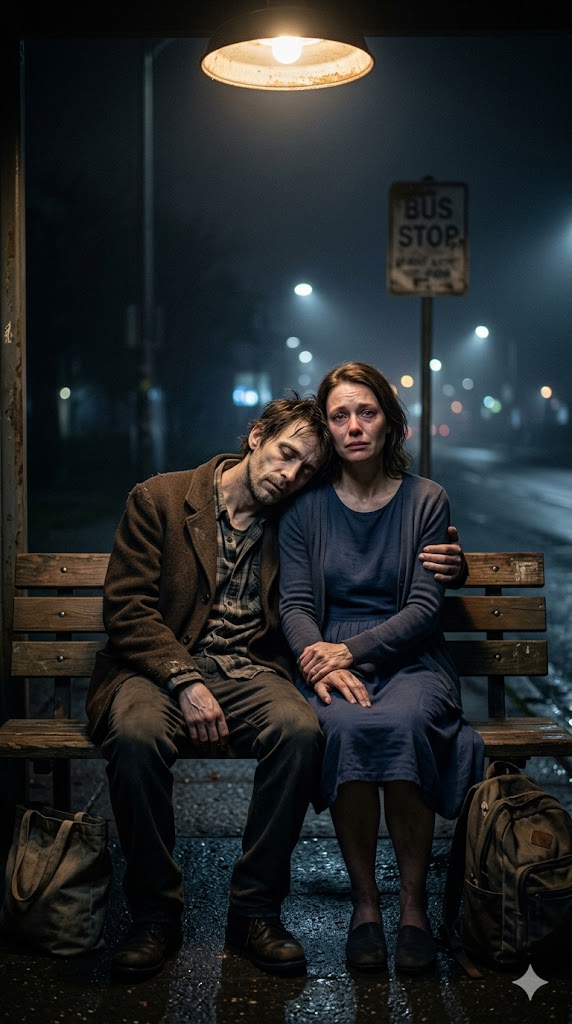
The walk to the bus stop was agonizingly slow, the cold wind biting through our thin coats. But as we sat on the wooden bench under the flickering streetlamp, David rested his head against my shoulder. We had nothing. Our bank account was empty, our clothes were worn, and the world had made it abundantly clear that we did not matter to them. Yet, sitting there in the biting cold, I felt a strange, unshakeable peace.
The glass houses and the pitying glances of our old friends meant nothing. Wealth could be lost in a day, but the kind of love that quietly breaks its own heart to save yours is a fortune no bank can hold. We are poor in a world that only respects gold, but I would rather starve in his arms than feast in their cages.