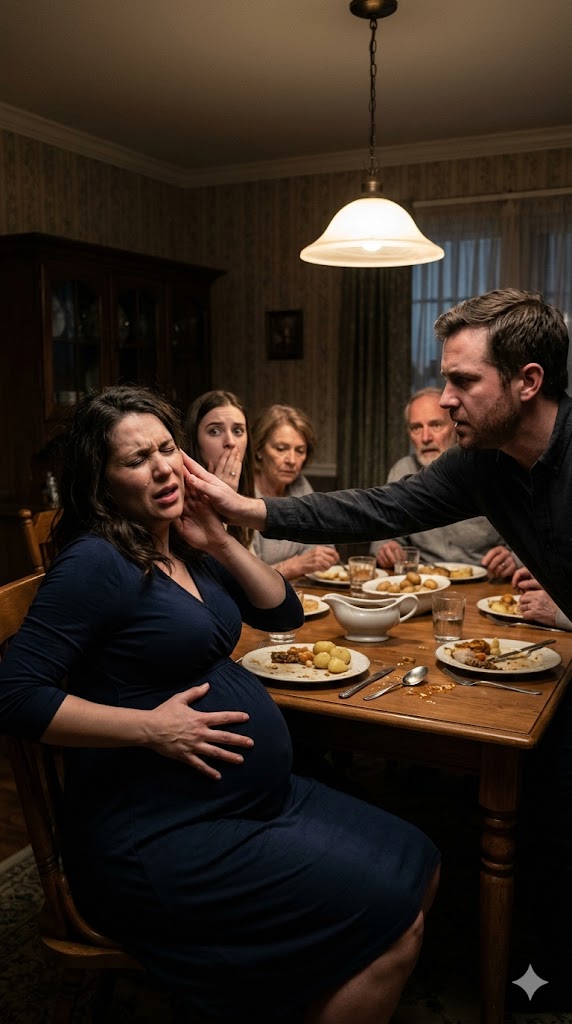
The air in the dining room was thick, not just with the smell of my mother-in-law’s roasted chicken, but with the familiar, suffocating tension that always seemed to follow Mark. I sat at the edge of my seat, my eight-month round belly pressing against the table, trying to breathe evenly.I remember when Mark’s presence used to feel like sunshine. We were married three years ago on a breezy beach, full of laughter and promises about the big, happy family we’d raise.
But the sunshine had faded slowly, replaced by unpredictable storms. The critical comments about my cooking turned into shouting matches over finances, and then, eventually, into the icy silence I now lived in.Throughout this pregnancy, a time I thought would be filled with joint excitement and care, I’d mostly felt alone and afraid. He’d become resentful of the attention I needed, the appointments, the sheer physical space I occupied.”
Pass the potatoes, Elena,” Mark said sharply, snapping me out of my thoughts. I realized I’d been staring at my plate. My hands felt clumsy as I reached for the bowl.Then, it happened. The serving spoon slipped, clattering loudly onto his plate, splashing a bit of gravy onto his shirt cuff.The sound of the spoon was nothing compared to the slap that followed.
It wasn’t loud, not really. Just a sharp, wet thud against my cheek. My head snapped back, and my hands instinctively flew up, not to my face, but to cup my stomach, a silent, desperate shield over my unborn daughter.
The silence that followed was deafening. It was a thick, heavy thing that settled over the table, smothering the cheerful chatter that had existed moments before. No one moved. My mother-in-law stopped mid-chew, her eyes wide. Mark’s father looked down at his plate, suddenly intense about slicing his chicken. My own sister, seated opposite me, averted her gaze, her face flushing crimson.
Mark just sat there, breathing heavily, staring at his gravy-stained cuff as if that was the true tragedy.Shame, hot and prickling, washed over me. It was worse than the stinging on my cheek. It was the public exposure of the private hell I’d been living. Everyone knew now. And yet, their silence spoke louder than any apology or defense could have. It was the sound of permission. They were choosing his comfort over my safety.
Later, hiding in the bathroom, I caught my reflection in the mirror. My cheek was already turning a dull red. I broke down then, a quiet, shuddering sob that I choked back, terrified he would hear. The realization settled deep in my bones: I was completely isolated in this house.But as I stood there, defeated, I felt it.
A strong, distinct kick against my ribs.It was the turning point. That small, persistent movement was a reminder of the life I carried, a life that was entirely dependent on me. My internal conflict—the terrifying thought of leaving versus the crushing despair of staying—clarified instantly.
The moral lesson hit me with sudden force: my silence was complicity. By enduring this, I was teaching my daughter that this treatment was acceptable. I realized then that my worth wasn’t defined by his anger, or by his family’s approval, but by the strength I needed to protect us both.
I washed my face with cold water and squared my shoulders. The courage didn’t arrive with a roar; it came as a quiet, steely determination.I didn’t pack a bag that night. I didn’t make a scene.
But when I walked back into the living room, I didn’t look down. I looked at Mark, and for the first time in years, I didn’t feel afraid of his gaze.The silence that followed me out of that house a week later was different. It wasn’t heavy with shame or complicity; it was light, filled with the terrifying, beautiful sound of possibility.
I had to break the silence, because I refused to let it become the soundtrack of my daughter’s life.