The key still caught in the front door of the house on Elm Street, requiring that familiar upward jiggle before the lock finally gave way. Pushing the heavy oak door open, I stepped into a silence so thick it felt like a physical weight.
The air smelled of old paper, dried lavender, and the phantom trace of vanilla extract that seemed permanently woven into the floral wallpaper. Nana had been gone for two weeks, but standing in her foyer, it felt like she might walk out of the kitchen at any moment, wiping flour on her apron, her eyes crinkling into half-moons behind her wire-rimmed glasses. I walked slowly through the living room, the floorboards creaking their familiar, rhythmic greeting. This house had been my sanctuary. When my parents were arguing, or when middle school felt like the end of the world, Nana’s house was the safe harbor.
I would sit at her yellow Formica kitchen table, snapping fresh green beans into a ceramic bowl while she stood at the stove. “Patience, little bird,” she used to tell me, her hands—soft, with paper-thin skin mapped by blue veins—gently guiding mine as I struggled to fold a pie crust. “The best things in life take time to settle.”Back then, those words were just about baking. I didn’t realize she was teaching me how to survive.
But as I grew older, time became the one thing I never had enough of. I moved to a city four states away. I chased promotions, deadlines, and a fast-paced life that left little room for the slow, quiet afternoons on Elm Street. Our long talks turned into hurried Sunday phone calls, which eventually turned into voicemails. *“Just calling to hear your voice, sweetie. No need to call back. I love you.”*I had dozens of those voicemails saved on my phone, sitting there like unread apologies. I always thought there would be a “next weekend” to visit, a “next holiday” to sit at her table. Then came the diagnosis.
Dementia is a cruel, quiet thief. It didn’t take her all at once; it stole her in pieces. The guilt of my absence became a heavy stone in my chest. By the time I finally cleared my schedule to fly home for a week, the Nana who knew how to fold a pie crust was slipping away. During my last visit, she had looked at me with cloudy, frightened eyes and called me by my mother’s name. I had held her frail hand, swallowing the bitter pill of my own regret, wishing I could trade every overtime paycheck for just one more afternoon of snapping green beans.
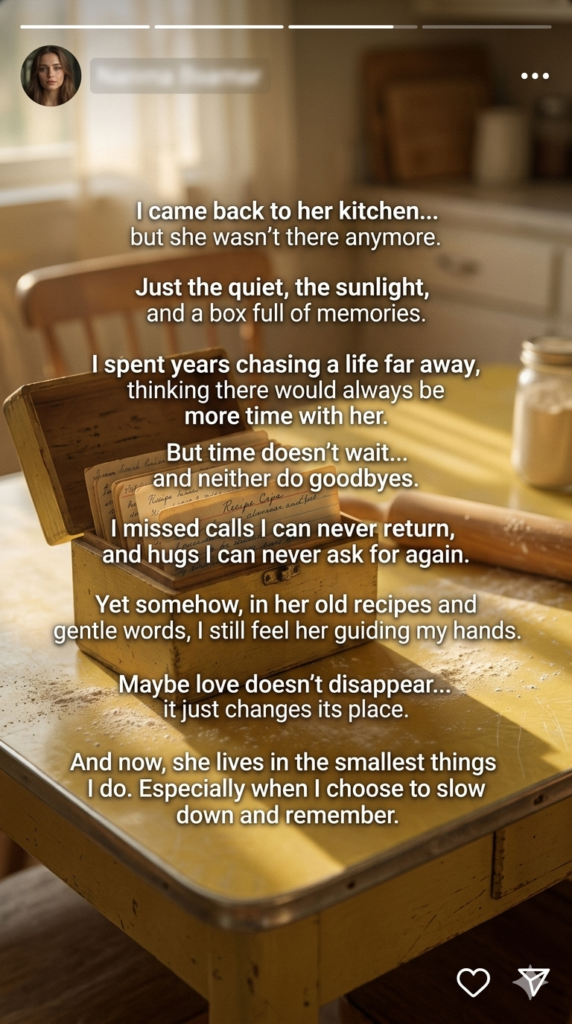
Now, I was here to pack up her life into cardboard boxes. I started in the kitchen, the heart of the house. As I emptied the pantry, my hand brushed against something pushed far back on the top shelf: her old, battered wooden recipe box. The hinges squeaked as I opened it, revealing dozens of index cards stained with decades of butter and vanilla. I flipped through them, the familiar cursive handwriting bringing a fresh wave of tears to my eyes.
Then, tucked behind the recipe for her famous cinnamon snickerdoodles, I found a card that looked different. It wasn’t a recipe. It was a note, written on the back of an old grocery receipt, dated three years ago—right around the time her memory first started to fade. *“For my Maya,”* the shaky handwriting read. I sank into the nearest kitchen chair, my hands trembling.*
“If you are finding this, I am probably gone, and my mind likely went a bit before my body did. I know you, little bird. I know you are sitting there carrying the weight of the world, feeling guilty that you didn’t come home enough. Don’t you dare.* *A garden doesn’t bloom if the seed insists on staying in the dirt. You were meant to grow out there, in the big, bright world. I didn’t need you sitting in my kitchen to know you loved me. I watched you fly, and that was enough for my heart. I have loved every version of you.
Now, wipe your tears, go make these cookies, and don’t skimp on the cinnamon. Love, Nana.”*I pressed the small, fragile piece of paper to my chest, and for the first time since her funeral, I completely broke down. I sobbed until my ribs ached, letting out years of hoarded guilt, missed calls, and unspoken I-love-yous. But as the tears finally slowed, the heavy, suffocating silence of the house felt different. It didn’t feel empty anymore. It felt like an embrace.
I stood up, wiping my face, and walked over to the oven. I didn’t pack the kitchen that day. Instead, I pulled out the flour, the sugar, and the cinnamon. I measured the ingredients with careful hands, remembering the gentle weight of hers over mine. I realized then that she wasn’t truly gone. She was in the patience I used when life got difficult. She was in the comfort I offered to my own friends. She was baked into the very foundation of who I had become.
**We spend our lives terrified of losing the people we love, never realizing that the deepest kind of love doesn’t leave when the person does; it simply moves inside us, becoming the voice that guides us home.