The flashing red and blue lights reflecting off our neighbor’s pristine vinyl siding at 2:00 AM was a sight I never thought I’d see. I stood on the front porch in my slippers, the cool October air biting through my flannel shirt, as a local deputy escorted my seventeen-year-old son, Leo, up the driveway. Leo’s head was down, his hoodie pulled low. He reeked of cheap beer and bonfire smoke. He and his friends had been caught trespassing at the old quarry on the edge of our subdivision, a place notorious for underage drinking and broken glass. “Just a warning this time, Mr. Hayes,” the deputy said, his voice a low rumble.
“But he’s skating on thin ice.”When the cruiser pulled away, the silence in our suburban home was deafening. Inside, my wife, Sarah, was sitting at the kitchen island. She didn’t yell. She just pressed a damp tissue to her eyes, her shoulders shaking in quiet, muffled sobs. That was worse than screaming. We hadn’t raised him for this. We were the family that did Sunday dinners, helped with science fairs, and stood on the sidelines of every freezing soccer game.
But somewhere in the last year, a chasm had opened up. Leo’s bedroom had become a fortress. Our living room was constantly littered with his rebellion—half-empty Monster energy cans left on the coffee table, a tangled headset dropped on the rug, and unsorted college prep homework shoved under the sofa cushions. He was drifting, pulled away by a neighborhood crowd that thrived on apathy and late-night texts.The next morning, the tension at the breakfast table was thick enough to choke on.
The only sound was the scrape of Leo’s spoon against his cereal bowl. “You’re grounded. Indefinitely,” I said, keeping my voice steady, though my heart was hammering against my ribs. “No car, no Xbox, no hanging out at the quarry. You go to school, and you come straight home.”Leo dropped his spoon. It clattered against the porcelain. “I wasn’t doing anything wrong, Dad! Everyone goes out there.
You and Mom are just obsessed with making me look like some perfect, robotic honor student.””We are obsessed with keeping you alive and out of jail!” I shot back, my firm resolve cracking. “You don’t get it!” he yelled, kicking his chair back. “You don’t get the pressure! You just care about the rules!” He stormed off, slamming his bedroom door so hard the framed family photos in the hallway rattled. The next few weeks were a miserable war of attrition.
The morning car rides to his high school were suffocating. I would grip the steering wheel of the Honda, the heater humming in the background, trying to find a way in. *How’s math going? Did you talk to Mr. Davis about your grade?* I’d get nothing but single-syllable grunts and a heavy, defensive stare directed out the passenger window. Every attempt to lay down the law only seemed to build the wall between us higher. I was losing my son, and my tight grip was only choking him.
The breaking point came on a rainy Saturday. I found another lie—a skipped history exam he swore he had taken. I was furious, ready to march into his room and strip away whatever privileges he had left. But as I stood outside his door, I heard something that stopped me dead. He was crying. Not the loud, angry tears of a teenager, but the quiet, ragged gasps of a kid who is drowning and doesn’t know how to ask for a life preserver.
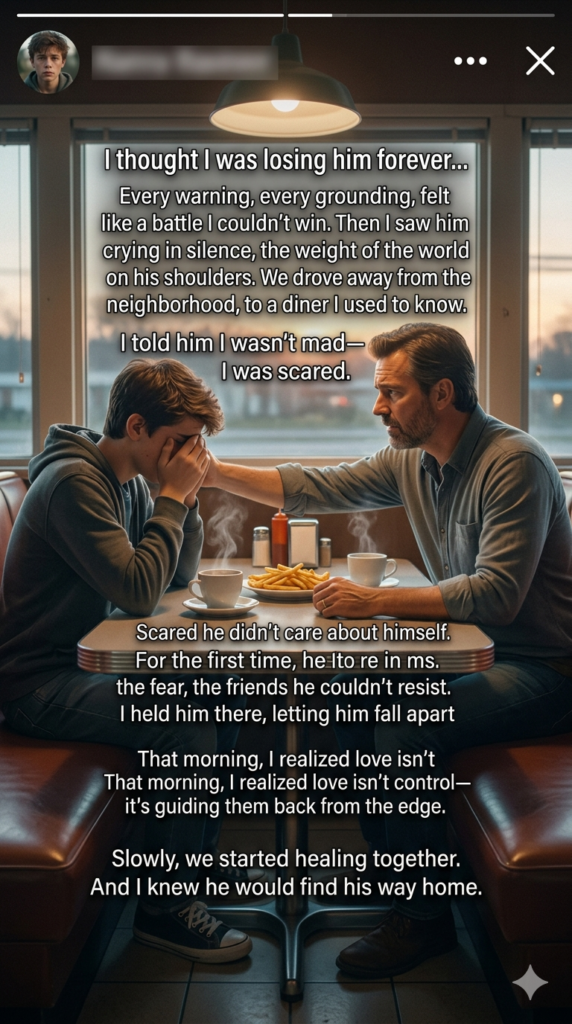
I took a breath. I didn’t yell. Instead, I opened the door. He scrambled to wipe his face, putting up his tough facade. “Put your shoes on,” I said quietly. “We’re going somewhere.””I’m grounded,” he muttered.”I know. Get in the truck.”We drove in silence, leaving the manicured lawns of our subdivision behind. I didn’t take him to a therapist’s office or the police station to scare him straight. I drove forty minutes out of town, pulling into the gravel lot of a faded, aluminum-sided diner on Route 9, right next to Miller’s Pond.
It was a place my own father used to take me when I was a teenager carrying too much anger and nowhere to put it.We sat in a vinyl booth, the smell of burnt coffee and fried bacon hanging in the air. I ordered two black coffees and a plate of fries. Leo looked confused, defensive. “I came here when I was eighteen,” I started, tracing the rim of my ceramic mug. “I had just gotten caught stealing a street sign. I was failing physics.
I thought my dad was going to kill me. But he brought me here, and he told me something I never forgot.”Leo finally looked at me, his guard dropping just a fraction. “What?””He told me that he wasn’t mad that I messed up. He was terrified that I didn’t care about myself enough to stop.” I leaned forward, looking my son right in his bloodshot, exhausted eyes. “I don’t care about the perfect grades, Leo. I care about *you*. The drinking, the sneaking out, the failing… you’re trying to numb something. And I’m sorry I’ve been too busy being a warden to be your father. But whatever is heavy on you right now, you don’t have to carry it alone.”
For a long moment, the only sound was the clatter of plates from the diner kitchen. Then, Leo’s tough exterior shattered. He put his head in his hands, right there over the table, and wept. He poured it all out—the crushing anxiety about college, the feeling that he was falling behind his peers, the pressure of his friends pulling him in directions he didn’t want to go, but feeling too weak to say no. I moved to his side of the booth and put my arm around his shoulders, holding my boy for the first time in what felt like years. Things didn’t magically fix themselves overnight. There were still missed assignments, still moments of frustration, and he still had to earn back our trust and his car keys. But the war in our living room ended that morning at the diner. The empty energy cans were replaced by textbooks as we spent evenings at the kitchen table, mapping out his assignments together. Sarah’s tears of worry turned back into smiles of relief as she watched us talk again.
I learned the hardest lesson of fatherhood: love isn’t about building a fence to control them; it’s about being a lighthouse to guide them back when they inevitably hit the rocks. You can’t force a teenager to be perfect, but if you meet them in their darkest moments with empathy instead of just a gavel, they will usually find their own way home.