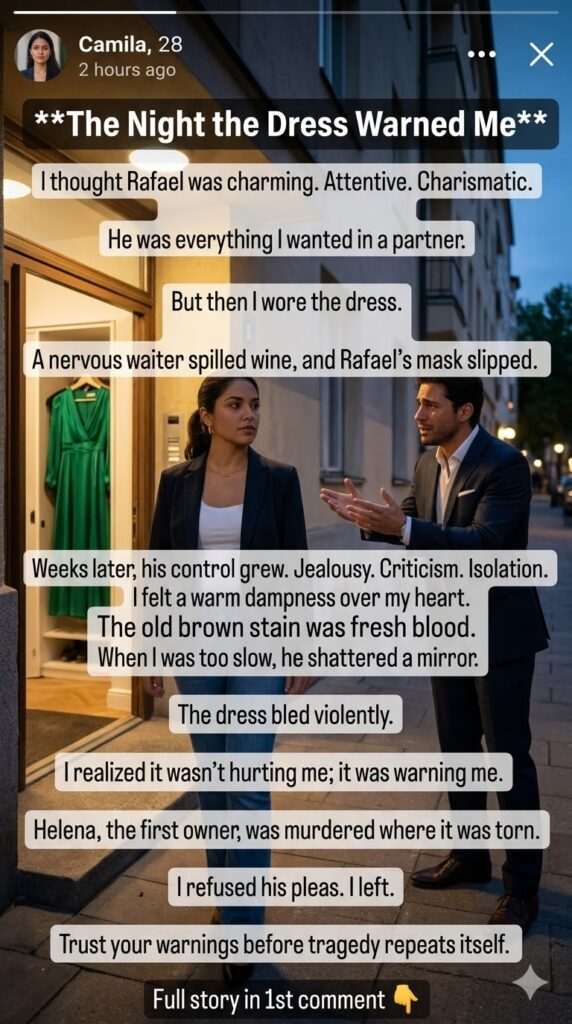
From a young age, many women are taught to doubt their instincts. When something feels wrong, society often pressures them to ignore that inner warning and be “understanding.” Camila, a twenty-eight-year-old graphic designer living alone, believed she had a quiet, normal life—until the day she wandered into a cluttered antique thrift shop called The Moth’s Trunk. Among racks of old clothing, she discovered a stunning emerald-green silk dress from the 1970s. It fit her perfectly, though she noticed a carefully repaired tear over the heart and a faint brown stain. The elderly shop owner sold it to her with an odd warning: never wash it with hot water, and if the dress ever gives a warning, don’t ignore it.
A few weeks later, Camila wore the dress on a dinner date with Rafael, a charming and successful lawyer she had met online. At first, the evening seemed perfect. Rafael was attentive, polite, and charismatic—everything one could want in a partner. But when a nervous waiter accidentally spilled a few drops of wine near his plate, Rafael’s friendly mask vanished. His voice turned cold and harsh as he humiliated the waiter in front of everyone. At that exact moment, Camila felt something strange: a warm dampness spreading over the left side of her chest.
When she checked in the restroom mirror, the old brown stain on the dress had turned into fresh red blood. Terrified, she searched her skin for a wound, but there was none. The blood was coming from the dress itself. Confused and shaken, she cleaned the stain and returned to the table, convincing herself it must have been some strange coincidence.
Over the next two months, Camila’s relationship with Rafael deepened—but so did the subtle control. His jealousy disguised itself as concern. He criticized her clothing, questioned her schedule, and slowly pushed her away from friends. Each demand seemed small on its own, and she compromised little by little, believing love required patience and sacrifice. Without noticing, she was shrinking her world to fit his expectations.
One night, while preparing for a birthday celebration for Rafael, his temper exploded again. Furious that she wasn’t ready quickly enough, he shouted at her and smashed his fist into a mirror beside her, shattering glass across the floor. As fear filled the room, the dress reacted violently. The stitched tear burst open and thick blood poured across the emerald silk, soaking her chest and dripping onto the floor. Camila begged for help, but Rafael ignored the horror and blamed her for making him angry.
That moment shattered the illusion. While he stormed out, she realized the dress wasn’t hurting her—it was warning her. She cut off contact with Rafael, blocking his calls and messages as he alternated between insults, apologies, and manipulative threats. The next morning, desperate for answers, she returned to the thrift shop and demanded the truth from the old woman.
The shopkeeper told her about Helena, the dress’s original owner. Decades earlier, Helena had been murdered by her husband after years of escalating abuse. The fatal knife wound pierced exactly where the dress had been torn. Society excused the killer as a man who acted out of “passion,” leaving Helena’s death forgotten. But the dress carried the memory of that injustice. Now it reacted whenever anger and violence threatened the woman wearing it, bleeding as a warning before tragedy could repeat itself.Camila took the dress home and hung it in the front of her wardrobe as a reminder she would never ignore again. When Rafael later begged for forgiveness outside her building, crying and promising to change, she calmly refused.
Moral:
The earliest signs of abuse are often quiet and easy to dismiss, but instincts exist to protect us. Listening to those warnings—and leaving before violence grows—is the courage that saves lives.