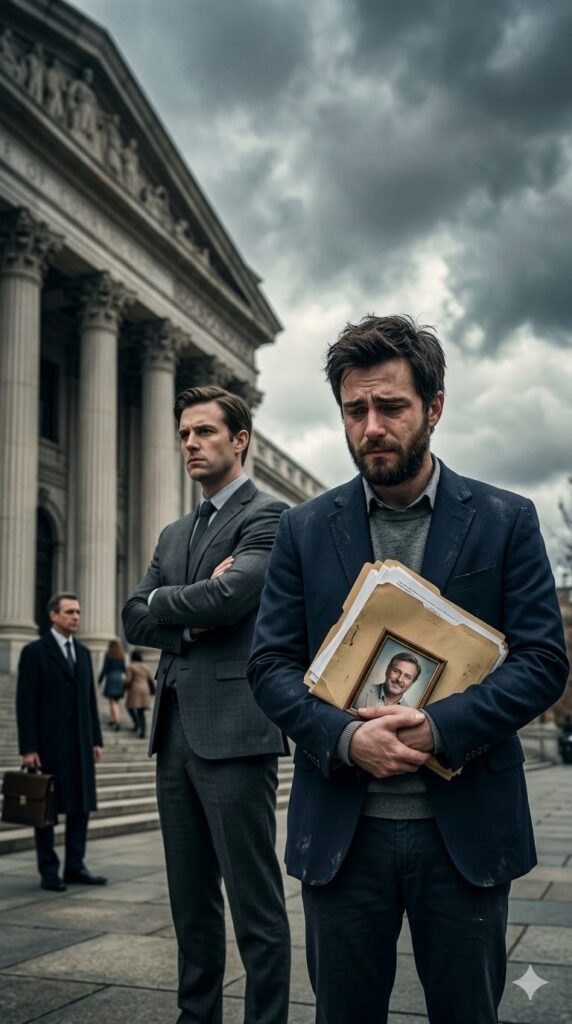
The world didn’t stop, and that seemed a profound injustice. It was a Tuesday when the doctor’s final words carved out the empty space inside my chest. He had been our sun, the steady beat of our lives, and in the afterglow of his departure, everything felt impossibly pale. We sat, my older brother Elias and I, in the silent, sanitized hospital waiting room, a space suddenly thick with the absence of him. The air tasted of sterile regret and a creeping, paralyzing fear. He had been healthy, until he wasn’t, a sudden collapse, a frantic race against a clock that had already decided to fail.
He had always made everything right, always had a plan, and now the world was a jagged, unpredictable thing, and we were two orphans trying to remember how to breathe without the air.Six months. We had spent them in a haze of grief, sorting through the fragments of a lifetime, holding tight to each other in the beginning. The large estate, the house where we’d scraped our knees and learned to drive, it was all supposed to be a shared burden, a split memory.
He had told us, countless times, of his will, a simple, equal divide, a legacy for us both to build upon. I had believed in that fairness, in Elias’s reassurance. Until the message. It was an email, clinical and brief, on a Tuesday, again. Elias wrote: “I have something difficult to tell you. Dad changed the will. He left everything to me. I’m sorry you had to find out like this.” The words blurred, my phone a cold, alien object in my hand. It was a mistake, a cruel joke. It had to be.The grief, once a heavy, manageable stone, splintered into a thousand jagged pieces. Disbelief curdled into a cold, crawling panic. I re-read the email, each word a physical blow.
The simple, logical future I had envisioned dissolved. Memories, once sources of comfort, became shadowed with doubt. Why would he change it? He loved me. The doubts, like weeds, choked out the truth. Elias’s quickness, the subtle shift in his demeanor since Dad’s death, the secret meetings with the lawyers – it all began to assume a sinister pattern. The foundation of our shared existence was not just cracked; it had been a lie, built on a future Elias had apparently already claimed.The truth did not arrive in a flash of revelation. It was a slow, agonizing crawl through whispers and half-truths.
I found it in the small things – a hidden journal entry from Dad, barely legible in his final weeks, full of confusion and pressure, his thoughts a chaotic swirl. Then a conversation with the nurse who had cared for him, her voice filled with a hesitant concern about the number of times Elias had shown up, a new lawyer in tow, while Dad was at his most vulnerable. The full picture emerged: Elias had used Dad’s frailty, his fear of being alone, to coerce him into changing the will. He hadn’t just inherited the money; he had manipulated a dying man to secure it.
The betrayal was an ocean, and I was drowning. My brother, my protector, the one who knew the exact texture of my childhood, had treated our dying father as a piece of property to be won. The internal war raged. I loved Elias, the memory of who he used to be. But this new, calculating Elias was a stranger. Challenging the will meant a court case, publicity, the final, irrevocable shattering of our family bond. I spent countless sleepless nights, the ghost of my father a silent observer in my room, my tears hot and accusatory. But the moral imperative was clear. Greed, if left unchallenged, would not just consume the money; it would destroy the very essence of what my father had believed our family to be.I hired a lawyer. The first time Elias saw me with her, his face didn’t register guilt, but a calculated fury.
“Why can’t you just let it go?” he demanded. “It’s what Dad wanted.” His conviction, his continued lie, was another knife twist. The family split was complete, a line drawn in the sand of our childhood home. The aunts and uncles, the cousins who had always been a safety net, were forced to choose sides. The tension at family gatherings, if any happened at all, was a physical weight, the air heavy with unspoken accusations. I was the disruptor, the one who couldn’t accept the new reality, but I was the one who could no longer live a lie.
The courtroom was not the dramatic battleground of my imagination. It was a sterile, bureaucratic room, filled with judges, lawyers, and the clinical details of a tragedy. I had to testify, to pour out my grief, my suspicions, the intimate details of our shared family life, into a microphone, while a judge listened impassively and Elias watched, his eyes cold and defensive. My lawyer presented the nurse’s testimony, the subtle signs of manipulation, the timeline of events. The emotional toll was a physical agony, a public flaying of my most private self. I was not just fighting for my share; I was fighting to expose the grotesque truth of what my brother had become.
The verdict was not a moment of triumph. The judge’s words, confirming that undue influence had been used to change the will and that the original, equal split was reinstated, were not a victory chant. It was just a conclusion, a logical end to a brutal chapter. I sat, a hollowed-out version of the person who had started this fight, the win a pale thing compared to the cost. I looked across the courtroom, but Elias wouldn’t look at me. The silence between us, once filled with unspoken understanding, was now a bottomless chasm, an emptiness that no inheritance, however vast, could ever hope to fill.
I walked out of the courthouse, the air outside fresh and indifferent to the wreckage inside. Elias was already gone. We had one final, defining interaction – a legal document signed, a property division executed. No words were spoken. A nod, a signature, and he was a stranger I once knew, his silhouette fading into the city crowd. There were no grand emotional reconciliations, no apologies, just a clinical severance. I had obtained my rightful share, my inheritance, but I was rich only in legal justice and the profound, crushing knowledge of what I had lost. The family line had not just been broken; it had been erased.
I am not a victim, but I am a survivor of a different kind. I look at the money, the house, the physical remnants of my father’s life, and they are not sources of comfort, but monuments to a betrayal. I got my share, yes, but the victory is as bitter as a dead leaf. I realized that justice is a cold comfort when the price is the love you used to depend on. Money, I learned, isn’t just a medium of exchange; it’s a mirror that exposes the truest, ugliest reflection of the human heart, capable of corroding the most sacred bonds, until greed becomes the only family member left standing. My father’s true legacy, I now understand, wasn’t the fortune, but the love he had hoped would survive it. And that, tragically, is the only inheritance I will never get back.