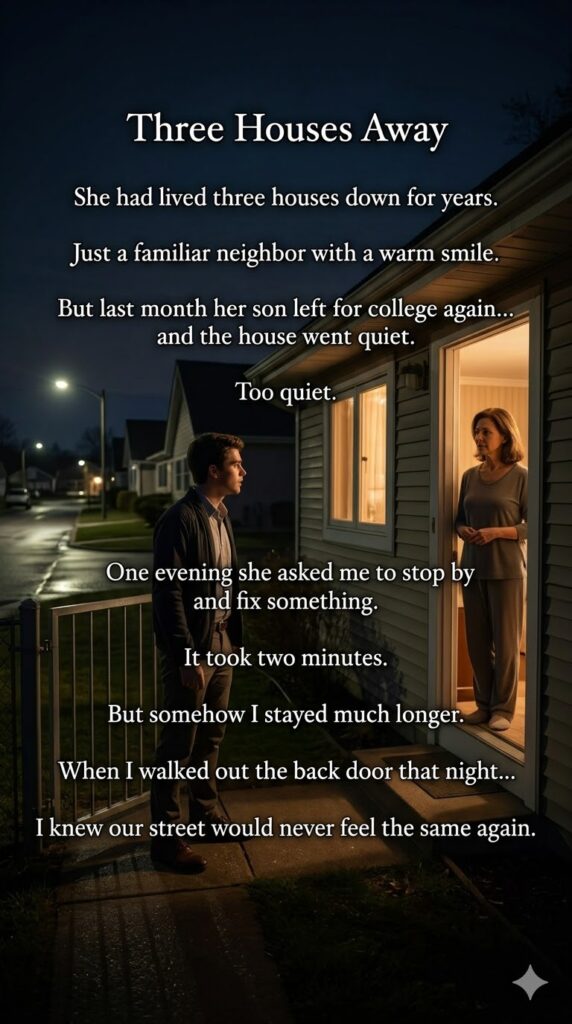
The American suburb possesses a very specific, heavy kind of silence. It is the sound of synchronized sprinklers clicking in the dark, the distant hum of central air conditioning, and the hollow echo of empty driveways.
For the three years I had lived in my small rental house on Elm Creek Road, I had found that silence comforting. But for Elena, living exactly three houses down, I suspected that same silence had recently become entirely deafening.Elena was thirty-nine, fourteen years my senior, and had been a fixture of the neighborhood long before I arrived.
I knew the broad strokes of her life the way you know the people you share a property line with: her husband had moved out two autumns ago in a U-Haul loaded with golf clubs and mid-century furniture, the divorce was finalized by spring, and her only son, a bright kid named Leo, had just packed up his Honda Civic to return to his sophomore year at a university three states away.For a long time, our interactions were strictly confined to the safe, invisible boundaries of suburban etiquette. We waved across the asphalt when taking out the recycling bins. We made brief, agreeable complaints about the humidity or the rising cost of property taxes. Occasionally, I would help her with the things that required a second set of hands—lifting a heavy terracotta planter onto her porch, or resetting her erratic WiFi router when the blinking red light frustrated her.
She would thank me, offer a bottled water, and I would return to my quiet life.But when September arrived and Leo’s car vanished from her driveway for the semester, a subtle shift occurred. The neighborhood grew darker earlier, and I began to notice the warm, solitary glow of her kitchen window late into the night.The brief conversations over the mailbox slowly migrated to her front porch. Then, one brisk Tuesday evening after I helped her drag a discarded mattress to the curb, she invited me inside for tea.
It started innocently enough. We sat at her large marble kitchen island, holding ceramic mugs, surrounded by the pristine, untouched order of a house that was suddenly too big for one person. She talked about Leo, her voice laced with that specific, hollow pride of a mother watching her child outgrow her.”
It’s strange,” she murmured one evening, tracing the rim of her mug. “You spend eighteen years complaining about the noise. The muddy shoes, the loud music, the constant slamming of doors. And then one day, they drive away, and the house gets so quiet you can hear the refrigerator running from two rooms over. You realize you’d give anything to have the mess back.”I listened, offering what little wisdom a twenty-five-year-old could.
But I understood loneliness. I understood the feeling of being unanchored, and in those quiet, dimly lit hours, our age gap seemed to dissolve, leaving only two solitary people seeking a brief harbor from the silence.The turning point came on a rainy Thursday in late October.My phone vibrated on my coffee table at eight in the evening. It was a text from Elena: *The garbage disposal is making a sound like a dying lawnmower. Are you busy? I’m terrified to put my hand down there.*I walked the three houses down, the cold autumn rain soaking the shoulders of my jacket.
When she opened the door, the atmosphere felt different. She was wearing an oversized gray cashmere cardigan and worn-in denim, her feet bare, her hair pulled into a messy, damp knot. She looked tired, but remarkably beautiful in a raw, unguarded way.I fixed the disposal—a rogue spoon had slipped past the rubber guard—and turned to wash my hands. When I dried them and looked up, she wasn’t holding mugs for tea. Instead, she had two heavy crystal glasses resting on the counter, and was pouring two fingers of amber bourbon into each.”
I think we’ve graduated from Earl Grey tonight,” she said, offering a small, self-deprecating smile. “If you don’t mind.””Bourbon works,” I replied, my voice sounding a fraction tighter than usual.I took the glass, our fingers brushing briefly. The kitchen was lit only by the warm, amber glow of the under-cabinet lights. The rain lashed steadily against the glass of the sliding patio door. We leaned against the opposite sides of the kitchen island, the physical distance between us feeling both vast and dangerously narrow.
The conversation flowed differently with the alcohol. The polite, neighborly boundaries eroded. She talked about the humiliating reality of dating in her late thirties, the profound exhaustion of starting over, and the creeping fear that the best chapters of her life were already printed and bound.”Do you ever feel like you’re just a ghost haunting your own life?” she asked quietly, looking down into her glass. “Like you’re just waiting for something to happen, but you have no idea what it is?””Every day,” I admitted. I stepped around the corner of the island, moving closer to her. “I think loneliness makes everyone feel a little transparent.”She looked up at me.
Her eyes were dark, reflective, and carrying a heavy, unspoken weight. The air in the kitchen suddenly felt incredibly thick. The rhythmic ticking of the wall clock seemed to amplify. I realized I could smell the subtle, clean scent of her shampoo, mixed with the sharp warmth of the bourbon.Neither of us moved away. The hesitation hung between us, heavy and terrifying. I saw the slight tremor in her hand as she set her glass down on the marble. She let out a soft, nervous breath that sounded almost like a laugh, a sound born of sheer vulnerability.”This is probably a mistake,” she whispered, her eyes flickering down to my lips and back up again.”
Probably,” I breathed.When I leaned in, crossing that invisible, heavy line, she met me halfway. The kiss was hesitant at first, clumsy with surprise, but it quickly deepened, fueled by weeks of quiet conversations and the desperate, sudden relief of being touched. There was a strange, intoxicating mix of profound comfort and sharp, electric guilt. We held onto each other by the edge of the counter, her hands tangling in the fabric of my jacket, pulling me closer against the chill of the rainy night.
It wasn’t frantic; it was deep, searching, and overwhelmingly human.But the real world rarely allows you to hide in those moments forever.When the initial rush subsided, the reality of our geography crashed back in. We pulled apart, breathing heavily in the dim light. The silence of the house rushed back in to fill the space around us. Elena stepped back, pulling her cardigan tighter around herself, a flush creeping up her neck. The vulnerability in her eyes had been replaced by a sudden, anxious clarity.”
The neighbors,” she murmured, looking toward the front window, though the blinds were tightly drawn. “Mrs. Gable is always looking out her window…””I know,” I said gently, stepping back to give her space. The sudden physical distance felt incredibly cold. “It’s okay, Elena. I should probably go anyway.”We didn’t know how to say goodbye. The script for this didn’t exist. She walked me to the kitchen door, the one that led out to the back patio, keeping me out of sight from the street.”I’m sorry,” she whispered, holding the door open. “I just… my head is a mess right now.””You don’t have to apologize,” I told her, stepping out into the cold, damp night. “Goodnight, Elena.”
I slipped out through her back gate, the wet grass soaking my shoes as I walked the short distance back to my own dark, empty house. I lay awake for hours, staring at the ceiling, replaying the evening, completely unsure if I had just ruined a rare, comforting friendship or stumbled into something far more profound.For the next four days, the neighborhood returned to its agonizingly normal rhythms. I saw her on Tuesday morning as I was backing out of my driveway.
She was at her mailbox. She froze, clutching a stack of envelopes, and we exchanged a wave. It was a normal wave, but her eyes lingered on mine for a fraction of a second too long, carrying the heavy, unspoken weight of the rainy Thursday night in her kitchen. The tension was palpable, vibrating across the perfectly manicured lawns.We were two people balancing on the edge of a precipice, both entirely paralyzed by the fear of looking down.
On Friday evening, I was sitting on my couch, watching the muted television, resigned to the fact that we were going to pretend the moment had simply never existed. We were going to bury it beneath the quiet, suffocating rules of suburban life.Then, my phone vibrated on the coffee table. The screen lit up the dark room.*Elena:*
*The porch light burned out again. And the step stool is broken. Are you around tonight?*I stared at the glowing text for a long time. It was a simple favor. A completely ordinary, neighborly request. But as I picked up my jacket and looked out the window toward the soft, solitary glow of her house three doors down, I knew there was absolutely nothing ordinary about it.