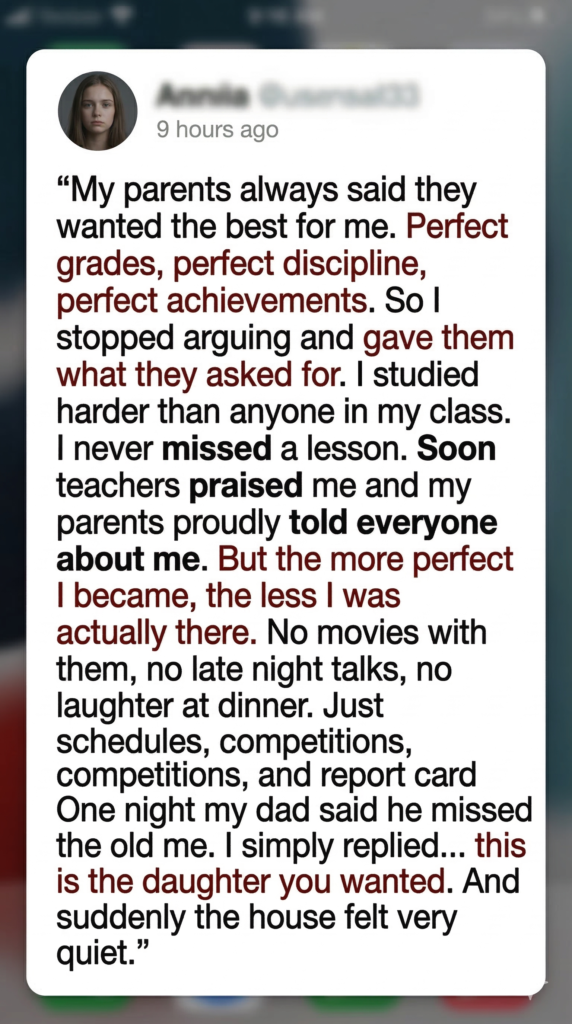
I didn’t run away from home. I didn’t scream, throw plates against the kitchen wall, or start intentionally failing my classes to prove a point. Instead, I executed the most devastating, quietly brutal rebellion a teenager could possibly orchestrate: I became exactly the daughter my parents always wanted.
In our house, being a “good kid” was never quite enough. My parents didn’t want a child who was messy, curious, or trying to figure herself out. They wanted a walking, talking college application.
They wanted perfect grades, a competitive sport, and a sophisticated extracurricular activity that looked impressive in family holiday newsletters. And the most insidious part was how they packaged their demands. It was never framed as control; it was always framed as love. “We just want you to have opportunities,” they’d say. “You’ll thank us later.”
What they didn’t realize was that when you demand a performance instead of a person, eventually, the person disappears entirely.When I was little, I was naturally quiet and creative. I loved drawing in sketchbooks, getting lost in massive fantasy novels, and writing my own stories about worlds where I actually had a say in what happened. I liked learning random, obscure facts just for the sake of knowing them. But in my parents’ eyes, if an activity didn’t come with a trophy, a certificate, or a GPA boost, it was a waste of time.
My mom took one look at my sketchbooks and declared drawing “useless.”
My dad told me that writing stories wouldn’t pay for out-of-state tuition. They both agreed I needed to be well-rounded, which in their vocabulary meant I needed an aggressive, team-oriented sport. So, they signed me up for club volleyball.I didn’t hate volleyball because the sport itself was terrible. I hated it because it felt like a mandatory shift at a job I had never applied for. Every practice, every tournament, every drill was an obligation. But if I ever dared to complain or ask for a weekend off, the lectures rained down.
“You never finish anything.” “You give up too easily.” “This is why discipline matters in the real world.”Then came the extracurriculars. I begged to join the high school art club or the creative writing seminar. The answer was a swift, unified “no.” My mom pushed for piano, but my dad wanted something he considered “more serious” and distinguished. They settled on the violin.
I had zero passion for the instrument, but my parents loved the aesthetic of it. A daughter who plays the violin sounds cultured and impressive to their friends. A daughter who writes fanfiction in her bedroom does not.For years, my life was a suffocating, repetitive loop. School. Volleyball practice. Violin lessons. AP Homework. Repeat.
Despite my exhaustion, it was never enough. If I brought home a 92 on a math test, they asked what happened to the other eight points. If I practiced violin for an hour, they asked why I wasn’t practicing for two. Every family dinner felt like a corporate performance review. “Did you study for chemistry? Did you talk to your coach about starting next game? Did you sign up for the regional competition? Did you finish your essay?”Not once did they ask if I was tired. Not once did they ask if I was happy.
The breaking point wasn’t a massive, cinematic blowout. It was something incredibly small, a tiny fracture that brought the whole house down.I was sitting at the kitchen island, exhausted after a three-hour volleyball tournament, staring blankly at my history textbook. I already had straight A’s and one B.
I rarely complained about my schedule anymore. I just put my head down and did the work.My dad walked past, tapped the counter, and sighed. “You know, you could be amazing if you actually tried.”Something inside my head just… snapped.It wasn’t a loud snap. It was quiet, like a lock clicking shut. I looked down at my textbook, and a sudden, freezing clarity washed over me. Fine, I thought. You want perfect? I’ll give you perfect. I will give you exactly what you asked for. Nothing more. Nothing less.
The following semester, I weaponized their expectations. I transformed myself into a machine.I studied like my actual life depended on it—not because I cared about the subjects, but because I cared about the strategy. Every test came back flawless. Every project was turned in three days early. My teachers began pulling my parents aside at open houses to praise my dedication.In volleyball, I became relentless. I never missed a single practice, never rolled my eyes, never complained about running extra sprints.
I stayed late to work on my serve until my shoulders ached. My coach started calling me the most reliable player on the roster. My parents were absolutely thrilled.Then came the violin. I practiced every single day without them having to utter a word. No sighing. No dragging my feet. I asked to join an advanced weekend masterclass. My mom practically wept with joy when my instructor told her how rapidly my technique was improving.
They finally had her: the perfect daughter.And that is exactly when my revenge began. Not by failing, but by succeeding so completely that it consumed every second of my existence. Because here is the undeniable truth about being perfectly successful—you don’t have time for anything else. Including your family.They started to notice the shift after a few weeks. I stopped lingering in the living room after dinner. I stopped coming down to watch movies on Friday nights. I stopped talking at the dinner table unless I was directly answering a question about my schedule or my grades.
If they wanted to go out to lunch on a Sunday, I couldn’t; I had an extra volleyball clinic. If they wanted to sit and talk, I couldn’t; I had three AP chapters to outline. If they wanted to play a board game, I couldn’t; I had to practice my violin scales.
I attended the mandatory holiday dinners and family obligations, but I was a ghost. I was physically present, but emotionally, I was a thousand miles away.And the absolute best part? They couldn’t complain. I was doing exactly what they had demanded. I was showing discipline. Responsibility. Commitment. Drive.One evening, my mom came into my room while I was highlighting a textbook. She stood in the doorway, looking uncomfortable. “We really miss spending time with you,” she said quietly.I didn’t even look up from the page. “I’m just focusing on my future.”
She swallowed hard and walked away. She didn’t know how to argue with her own favorite catchphrase.It went on like that for months. The perfect grades rolled in. The perfect attendance. The flawless recitals. But the house lost its heartbeat. There was no laughter echoing down the hallway. There were no spontaneous conversations, no inside jokes, no warmth. The house became pristine, quiet, and completely empty.
The final realization happened on a rainy Sunday afternoon. My dad knocked on my door and asked if I wanted to come downstairs. They were ordering pizza and putting on a movie I used to love.I looked up from my desk, my face completely blank. “I can’t. I have practice.” It wasn’t even a lie.He lingered in the doorway, his shoulders slumping slightly. “You always have something now,” he said, his voice laced with a sadness I had never heard before.I shrugged, turning back to my computer screen. “You told me this is what successful people do.”
A heavy, suffocating silence filled the room. For the first time in my entire life, my dad looked like he wasn’t sure if he was right. He didn’t tell me to quit anything. He didn’t tell me to relax. He didn’t apologize. He just slowly closed the door.
But they stopped asking why I wasn’t around after that. I think they finally understood the transaction they had made. They had relentlessly demanded a perfect daughter, and I had obliged. I became a perfect schedule, a perfect report card, a perfect athlete, and a perfect musician.But I was no longer their kid.When you push someone to be nothing but a resume, you shouldn’t be surprised when they stop acting like family. They got exactly what they asked for. And now, they have to live with it.