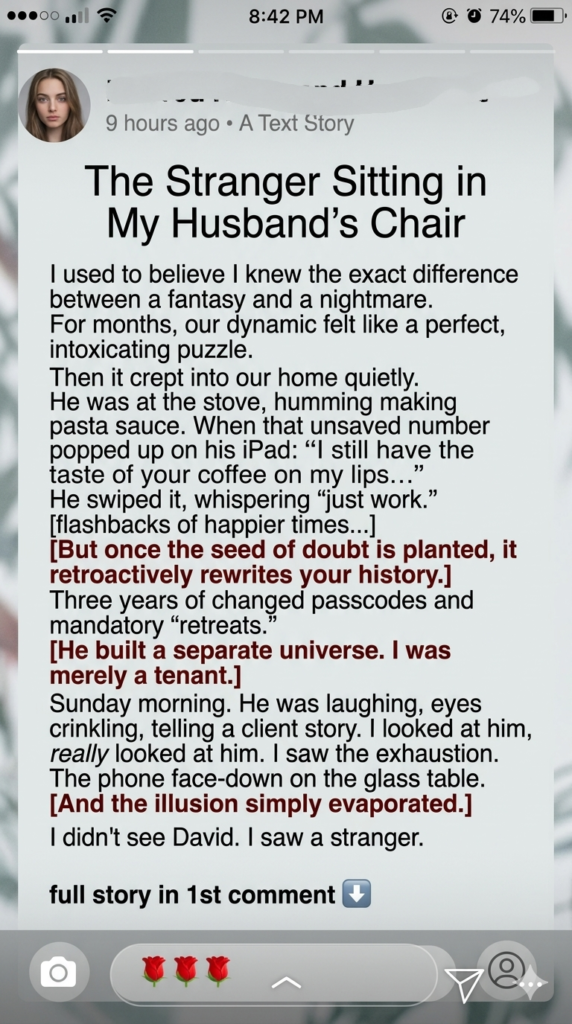
The betrayal didn’t announce itself with a smoking gun, a tearful confession, or a dramatic confrontation in the rain. It crept into our home quietly, wearing the face of the man I had loved for twelve years.
It started on a Tuesday evening. The house was filled with the familiar, comforting scent of roasting garlic and rain against the windowpanes. David was at the stove, humming softly as he stirred the pasta sauce. He was, by all accounts, a wonderful husband—attentive, gentle, and the kind of man who still remembered to buy my favorite tulips on his way home from work.
His iPad sat on the kitchen island, illuminating the dim room when a notification popped up. I was wiping down the counter, just inches away.“I still have the taste of your coffee on my lips. Be safe on the drive home.”
There was no name attached, just an unsaved number. For a fraction of a second, my brain tried to protect me. A wrong number. A spam message. A joke from a coworker. But then David turned around. He saw where my eyes were fixed, and in that microscopic space between heartbeats, his mask slipped. It was a flicker of pure, unadulterated panic, instantly swallowed by his usual warm smile. He smoothly picked up the tablet, swiped the screen, and kissed my forehead.”Just work,” he murmured.
I didn’t scream. I didn’t throw the dish towel. I just stood there, the foundation of my reality quietly fracturing beneath my feet.
The Architecture of Doubt
In the weeks that followed, I became a ghost in my own life, haunted by a thousand questions. Before I ever questioned him, I interrogated myself. Was I going crazy? Am I just an insecure woman looking for problems where there are none? I stood in front of the bathroom mirror tracing the fine lines around my eyes, wondering if I had simply stopped being enough. I weighed my flaws against his perfection. I convinced myself that I was paranoid, effectively gaslighting my own intuition to protect the sanctuary of our marriage.
But once the seed of doubt is planted, it retroactively rewrites your history. I began to look backward, and suddenly, the past three years came into a devastating, sharp focus.
Three years ago was when he got his promotion. It was when he changed the passcode on his phone “for corporate security.” It was when his occasional weekend golf trips became mandatory corporate retreats. It was when his vocabulary subtly shifted, incorporating phrases and jokes that didn’t belong to us.
The Weight of Two Lives
The hardest part wasn’t believing he was capable of lying; it was reconciling the liar with the man I loved. David wasn’t a monster. He didn’t suddenly become cruel or distant. In fact, he had been profoundly sweet.
When my mother passed away two years ago, David held me on the bathroom floor while I sobbed until I threw up. He stroked my hair and promised me I would never be alone. Now, the math of his betrayal hit me with a physical force: he had been loving someone else while wiping my tears. He had been sleeping with someone else when we renewed our vows last summer. He had built a completely separate universe, and I was merely a tenant in the half he allowed me to see.
He didn’t want to leave me; he just wanted to have us both. He was a complex, deeply flawed man who was too selfish to stay faithful, and too cowardly to leave.
The Quiet Shattering
The absolute truth didn’t come from snooping through his phone or hiring a detective. It came on a Sunday morning. We were sitting on the patio, drinking coffee. He was telling a story about a client, laughing, his eyes crinkling at the corners.I looked at him, really looked at him, and the illusion simply evaporated.
I saw the exhaustion behind his eyes—the fatigue of keeping his lies straight, of managing two women, of living a double life. I saw the phone resting face-down on the glass table. I saw the stranger sitting in my husband’s chair.I know, I thought. And you know that I know.
In that moment, the frantic anxiety that had gripped my chest for months completely vanished. It was replaced by a profound, chilling clarity. I didn’t feel the urge to scream, to demand the name of the woman, or to beg him to choose me. The realization was much simpler: I was holding onto a man who had let go of me three years ago.”I’m going to pack a bag,” I said quietly, setting my coffee mug down.
David stopped mid-sentence. The color drained from his face. “What? Clara, where are you going? What’s wrong?””I think you know,” I replied softly. I didn’t wait for his tears, or his excuses, or the inevitable, messy confession. I just turned and walked into the house.
The Courage to Walk Away
There is a specific kind of grief in mourning a person who is still alive, in grieving a marriage that was a beautiful mirage. It took every ounce of my strength to walk out the front door, leaving behind the house we built, the future we planned, and the man I still, despite everything, loved.But staying would have meant abandoning myself.
The Moral Lesson
Trust is the invisible architecture of love; once it is fundamentally broken, the house cannot stand, no matter how beautifully it is decorated. We often believe that true strength is found in fighting for our relationships, in enduring the unendurable to keep our families intact. But sometimes, the most courageous thing you can do is to look at the life you desperately wanted, accept that it is no longer real, and walk away.
Your self-worth is not defined by the person who betrayed you. It is defined by your refusal to accept a love that requires you to shrink, to doubt your own reality, and to settle for a fraction of a heart. Healing begins the moment you decide that your peace is more valuable than their presence.