The fluorescent lights of the grocery store always hummed a little too loudly, but today, they felt like a spotlight. We were in the cereal aisle when it started. Leo’s sensory overload peaked, manifesting as a high-pitched, rhythmic vocalization and the frantic flapping of his hands against the tray of his wheelchair. I was hurriedly tossing boxes into the cart, trying to outrun the meltdown, when I felt the gaze.
A woman a few feet away was staring. Her expression wasn’t overtly cruel, but it carried that familiar, suffocating cocktail of pity and judgment. She pulled her own perfectly quiet, able-bodied toddler a little closer to her leg, as if whatever Leo had might be contagious. I swallowed the lump of defensive anger rising in my throat, gently stroked Leo’s hair to soothe him, and wheeled us out of the aisle. *Just breathe,* I told myself. *Just breathe.*
Late that night, with the house finally wrapped in silence, I sat on the edge of Leo’s bed, watching his chest rise and fall. He looked so peaceful in sleep, his features soft and unburdened. It is in these quiet, midnight hours that my mind inevitably drifts back to the beginning.
I remember the day he was born with terrifying clarity. I had painted his nursery yellow. I had bought tiny soccer cleats. I had mapped out a whole lifetime of milestones in my head. But the delivery room was unnervingly silent. When the doctors finally sat my husband and me down weeks later, the medical jargon felt like a foreign language: *severe cerebral palsy, global developmental delay, non-verbal.*
In a single breath, the earth fell away beneath my feet. I didn’t just feel sadness; I felt a violent, blinding confusion. I lived in denial for months, dragging him to specialists, convinced that if I just worked hard enough, I could “fix” him. When the reality finally settled in my bones, I grieved. I grieved for the boy who would never run across a field, who would never drive a car, who would never say “I love you.” The years that followed were a grueling marathon. Nobody warns you about the sheer exhaustion of being a full-time caregiver. They don’t tell you about the crushing weight of the financial pressure—the stack of insurance denials, the cost of custom wheelchairs, the therapies that drain your bank account. And they certainly don’t prepare you for the profound loneliness. Friends slowly stopped calling. We stopped being invited to birthday parties because Leo’s sudden noises frightened the other children. People would look at me with sympathetic eyes and say, *”I don’t know how you do it. I could never.”*
They thought it was a compliment, but it always felt like a reminder of how isolated we truly were.
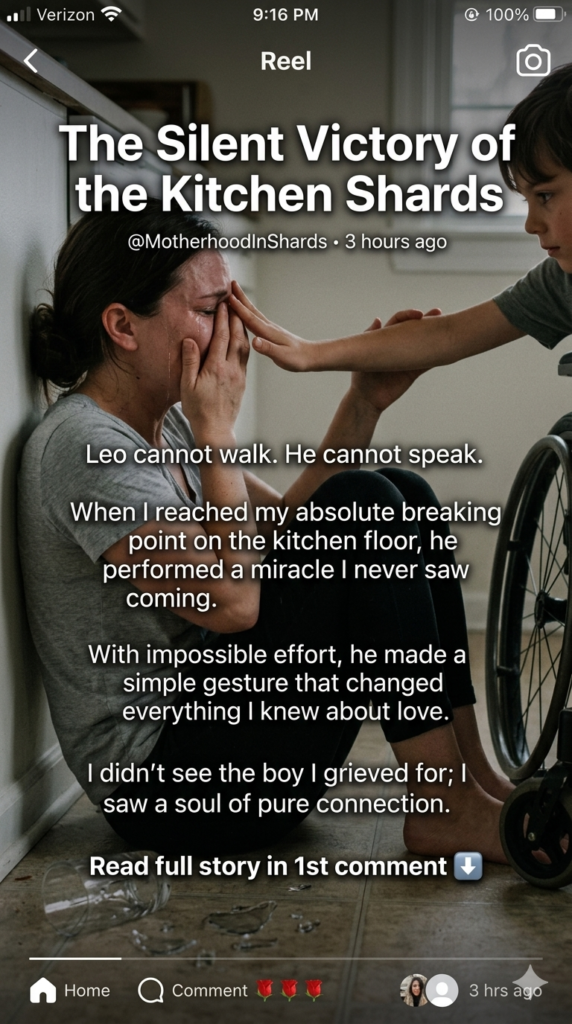
There are days when I feel strong, fiercely proud to be his advocate. But there are also days when I break. One Tuesday afternoon, everything shattered. The insurance company had denied coverage for his new feeding pump. I had barely slept in three days. As I was pouring myself a glass of water, my hand trembled, and the glass slipped, shattering into dozens of glittering, jagged pieces across the linoleum. I didn’t try to clean it up. I just sank to the kitchen floor, pulled my knees to my chest, and sobbed. It was a raw, ugly, defeated cry. I questioned everything in that moment—my faith, my strength, my entire purpose. *I can’t do this anymore,* I thought. *I am failing him. I am completely failing.*
Then, I heard the squeak of his wheelchair tires. Leo had managed to maneuver himself into the kitchen. He couldn’t speak to ask me what was wrong. He couldn’t bend down to pick up the glass. His muscles, which usually fought against his own intentions, were stiff and uncooperative. But as I sat there weeping, Leo forced his arm to move. It took an agonizing amount of effort, his face contorting in concentration, but he reached down. He didn’t try to hand me anything. He simply pressed his palm flat against the side of my wet, tear-stained cheek. He let out a soft, low hum—a sound he usually reserved for when he was feeling totally relaxed and safe. He locked his deep brown eyes onto mine, and in that gaze, I heard everything he couldn’t say. *I am here. We are okay. You are enough.*
In that beautiful, fragile moment, the truth washed over me. I had spent so much of my life mourning the milestones he would never reach, that I had been blinded to the miracles he performed every day. The time he finally learned to swallow solid food. The booming, chest-deep laugh that erupted from him when the wind hit his face. The pure, unfiltered empathy in his touch. Leo wasn’t a tragedy to be fixed. He was my greatest teacher. He was teaching me that love does not require words, and that worth is not measured by what a body can do.
**The Moral Lesson**
We spend our lives chasing an illusion of perfection, believing that happiness is found in flawless outcomes and met expectations. But true, enduring love is forged in the fires of adversity. It is found when we let go of the life we planned and bravely embrace the life we have. A person’s value is never determined by their physical or mental capabilities, but by the light they bring into the world. When we choose to see past the brokenness, we discover that the heaviest burdens often carry the most profound blessings. Strength isn’t the absence of tears or exhaustion; it is the courage to wake up, wipe your face, and fiercely love the beautiful, imperfect life standing right in front of you.