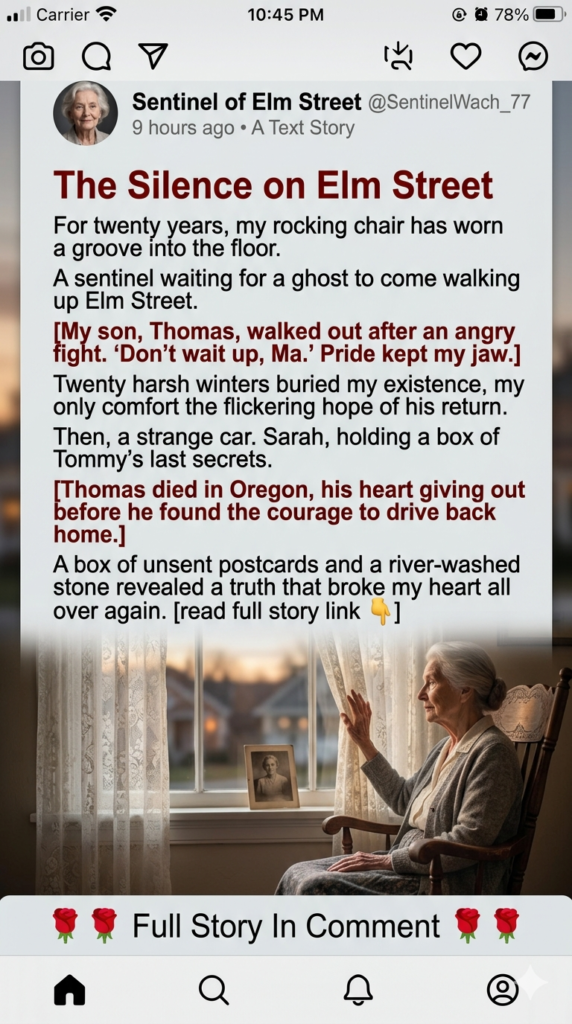
The oak floorboards beneath my rocking chair have worn down to a smooth, pale dip, shaped by two decades of silent vigil. Every morning, before the Pennsylvania frost melts off the dogwood trees in my front yard, I pull back the lace curtains and look down Elm Street. I know every crack in the asphalt, every stray cat that wanders past, and the exact angle the mail truck turns the corner. For twenty years, I have been a sentinel of my own heartbreak, waiting for a rusted blue Ford pickup to pull into the driveway.
I am waiting for my son, Thomas. The last time I saw him, he was nineteen, his face flushed with the kind of volatile, reckless anger only a teenage boy can muster. We had fought over nothing and everything—his grades, his friends, his suffocating need to escape this small town, and my terrifying need to keep him safe. He grabbed his duffel bag, threw his keys onto the kitchen counter, and yelled, “Don’t wait up, Ma. I’m never coming back.” I let him walk out the door, pride locking my jaw. I thought he’d be back by dinner. Dinner turned into midnight, midnight into a week, and a week into a lifetime.
Slowly, imperceptibly, my life shrank to the dimensions of this living room window. I watched twenty harsh winters bury the town in silent, suffocating white, and twenty humid summers bake the grass brown. The neighbors next door moved away, replaced by a young couple, then a family with three kids who grew up, played in the sprinklers, and eventually left, just as Thomas did. My birthdays passed as quiet, hollow echoes. Thanksgiving turkeys were downsized to frozen dinners, and the Christmas tree stayed boxed up in the attic. My sister used to visit, gently placing a hand on my frail shoulder, urging, “Eleanor, you have to let him go. You have to live.” But how could I? If I stepped away, if I finally stopped looking, what if that was the exact moment he came walking up the path?
There were nights when the moonlight cast long shadows across the room, and the doubt would creep in, thick and suffocating. Had I sacrificed my own existence for a ghost? I had become a prisoner of my own hope, trapped in a purgatory of ‘what ifs.’ The guilt of those final, angry words anchored me to this chair. I traded the vibrant, messy experience of living for the sterile safety of waiting.
Then, yesterday afternoon, a car I didn’t recognize parked at the curb. A woman stepped out, her hair graying, holding a small cardboard box. She walked up my steps with a heavy reluctance. When I opened the door, she looked at me with eyes that mirrored my own exhaustion. “You’re Eleanor,” she said softly. “I’m Sarah. I knew Tommy.”My heart stopped. *Tommy*. Not Thomas. She handed me the box, her voice breaking. “He passed away last month in Oregon. His heart just gave out. He told me, if anything ever happened, to bring this to you.”
Inside the box was a collection of unsent postcards, dated across twenty years, from diners and gas stations across the country. And at the bottom, carefully wrapped in tissue paper, was a smooth, river-washed stone we had found together on a fishing trip when he was ten. The final postcard, dated just a few months ago, simply read: *Ma, I’m sorry I never found the courage to drive back down Elm Street. I love you.*
The tears I had held back for two decades finally broke, washing away the bitter dust of my pride and my paralyzing guilt. Thomas hadn’t been lost to me because he didn’t care; he had just been too broken, too scared of his own mistakes to find his way back. I walked over to the window, ran my hand along the fragile lace curtain, and for the first time in twenty years, I closed it.
**The Moral Lesson**
Hope is a beautiful anchor, but when left unchecked, it can easily become a chain. We cannot pause our lives waiting for the past to apologize, or for broken things to magically mend themselves in the exact way we envisioned. Forgiveness—both for others and for ourselves—does not require physical presence or a perfect resolution; it simply requires our willingness to let go. Life is not meant to be lived as a spectator through a pane of glass. It is meant to be felt, experienced, and embraced, moving forward even when our hearts are heavy with the weight of what we’ve left behind.